1. Introduction
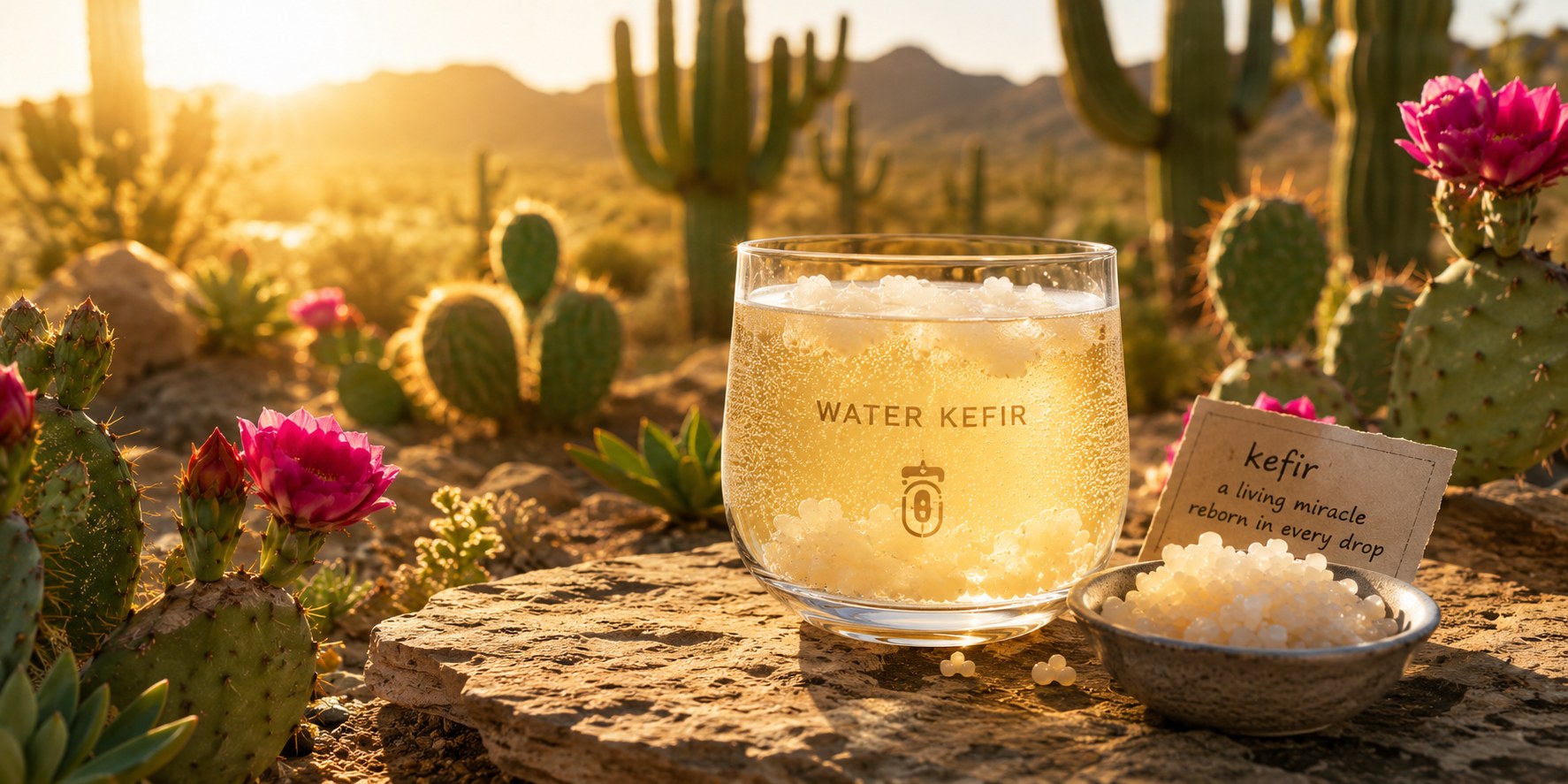
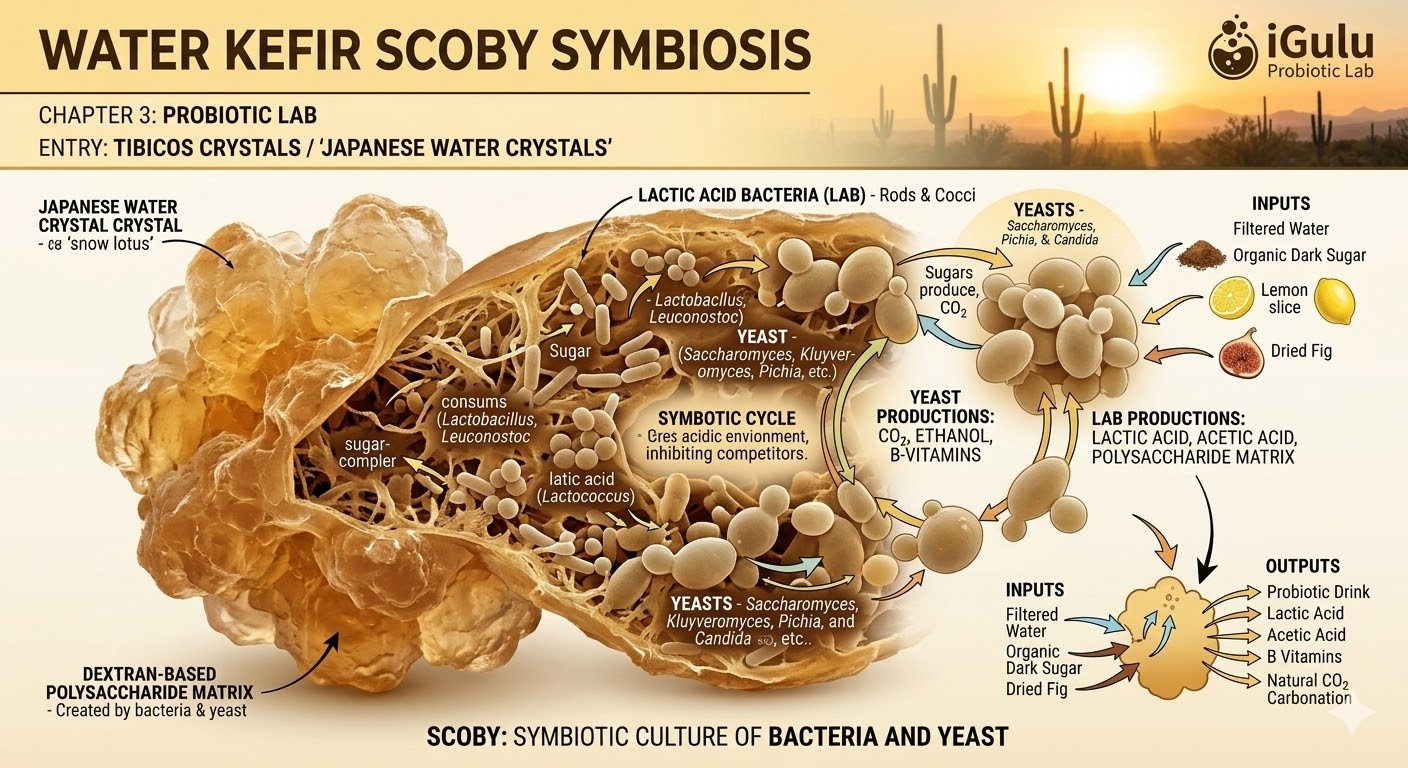
Water kefir is a low-alcohol, lightly sparkling fermented drink made from translucent gel-like grains — known scientifically as a SCOBY (Symbiotic Culture Of Bacteria and Yeast). Drop a handful of these crystal-like grains into sugar water, give them a day at room temperature, and what comes out is a clean, refreshing, faintly sweet-and-sour drink with the carbonation of a light champagne.
Unlike its dairy cousin, water kefir is completely milk-free — built on sugar water, fruit juice, or coconut water. It is one of the most accessible probiotic drinks a household can make: no dairy, no gluten, no specialized equipment beyond a vessel and a cloth cover, and the grains keep working for years if you treat them well.
This chapter walks through the cultural origins of water kefir, the biology of the grain, the standard iGulu-validated brewing parameters, and a flavor wheel for those who want to go beyond the base recipe.
2. History and Cultural Background
Mexican origin: "Mysterious dewdrops on the cactus"
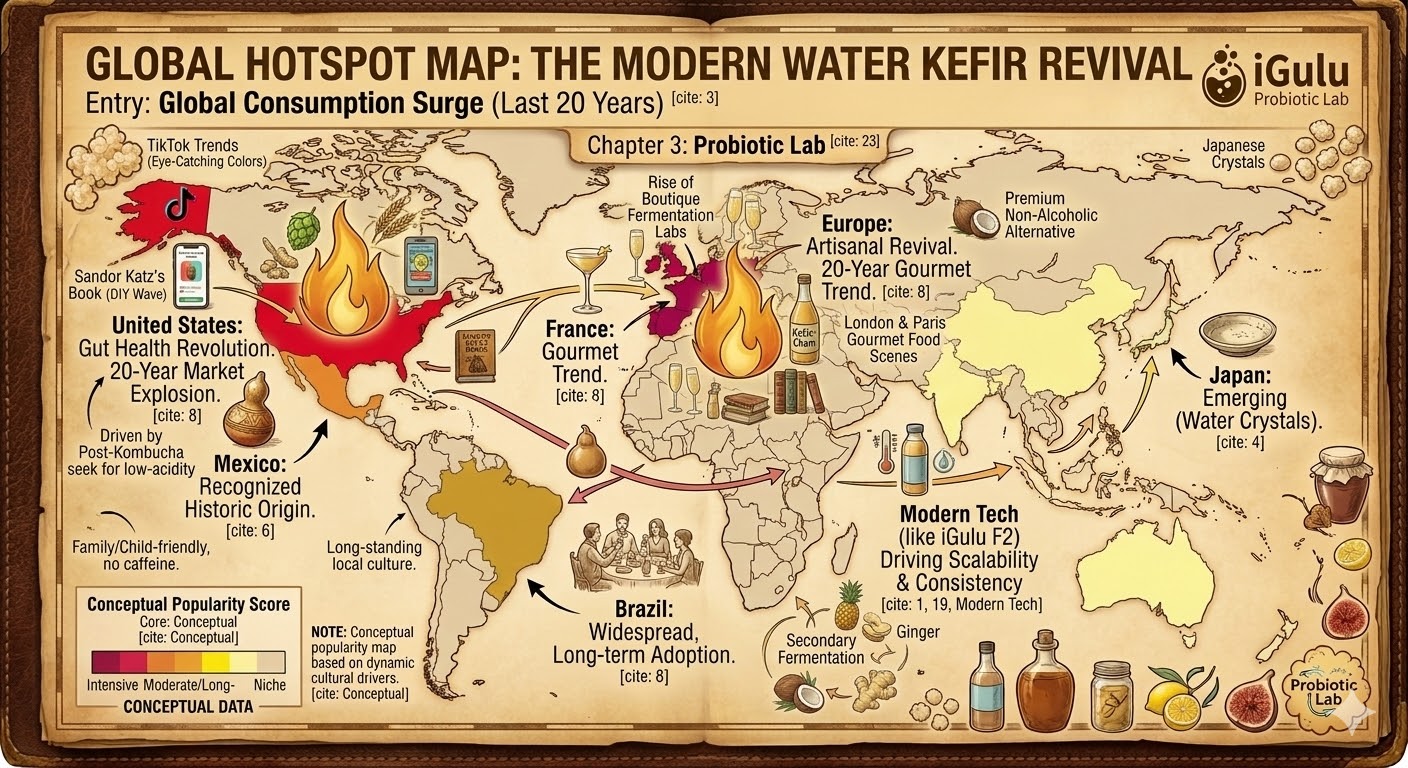
The story begins in 19th-century Mexico, on the arid plains scorched by relentless sun. Local nomadic tribes and villagers discovered that on the skin of the Prickly Pear Cactus, tiny, translucent, crystal-like granules would appear — as if dew had condensed into gemstones. Locals named them "Tibicos" — "little cactus."
When people collected these unassuming crystals and dropped them into simple sugar water, the once-still liquid awakened: tiny bubbles danced through it, releasing a refreshing champagne-like vitality. In a land starved for fresh water, Tibicos transformed plain sugar water into an energizing "water of life" — a treasured provision for desert crossings and a traditional healing remedy.
The Caucasus: "Grains of the Prophet"
The Caucasus Mountains, along the Russian-Georgian border, are the birthplace of the entire kefir family. Historians and microbiologists believe early nomadic peoples likely used similar cultures to ferment sugar water, fruit juice, and even honey water alongside their famous dairy kefir.
For Caucasian peoples — particularly the Karachay and Balkar — these grains were considered "Grains of the Prophet" — a gift from God. They guarded the culture as a closely kept secret, refusing to share it outside the family, believing that losing it meant losing their household's health guardian.
Germany's "poor man's champagne"
In late-19th to early-20th-century Germany, water kefir became a vital source of probiotics and energy for many German households. It earned the affectionate name "the poor man's champagne."
France's "Crystalline Water of Life"
Some traditions hold that Crusaders returning from the Middle East brought "crystal cultures" back to France. In certain Catholic monasteries in the south, nuns fermented grape juice or sugar water with these grains to produce a non-alcoholic restorative drink, known as "Eau de Vie Cristalline" — Crystalline Water of Life.
A global map
| Path | Core region | Local name | Substrate | Cultural meaning |
|---|---|---|---|---|
| Americas | Mexico, South America | Tibicos | Cactus sugar, brown sugar | A gift of life and energy in the desert |
| Asia | Japan, Northwest China | Crystal Tears / Snow Flowers | Rice sugar, mountain spring water | Tears of the gods — purity and spirit |
| Europe | Germany, Caucasus, France | Putzig / Kefir-Wasser / Eau de Vie Cristalline | Dried fruit, lemon, grape juice | Family secret, the poor man's champagne, the monastery's holy water |
3. Flavor Profile and Global Variations
Flavor profile
A well-made water kefir has a clean, refreshing character — somewhere between a light cider, a soft champagne, and a faintly tart soda. The bubbles are fine and lively, the acidity gentle (closer to a ripe apple than a lemon), and the residual sweetness depends entirely on how long you ferment.
The base flavor is shaped almost entirely by the sugar substrate: white sugar produces a clean, neutral canvas; brown sugar adds caramel and toffee notes; coconut sugar brings a distinctive nutty depth. The secondary fermentation — where you add fruit, ginger, or herbs to the already-fermented liquid — is where most of the flavor character actually comes from.
Global variations
| Region | Variation | Distinguishing character |
|---|---|---|
| Mexico (Tibicos) | Cactus-sugar base, lime + raisin secondary | Bright, citrusy, with the slightly mineral tang of unrefined sugar |
| Germany (Putzig) | Cultured on dried figs and lemon | Honeyed sweetness, gentle bubbles, a Sunday-table drink |
| France (Eau de Vie Cristalline) | Grape juice and white sugar base | Wine-adjacent, more aromatic; closer to non-alcoholic sparkling cider |
| Modern wellness market | Green tea or pomegranate base | Marketed as an antioxidant drink; deep color, herbal-tannic finish |
4. Characteristics
Flavor and mouthfeel
- Color: Slightly cloudy; pale yellow to amber depending on sugar source
- Aroma: Faintly sweet-and-sour, similar to a very light apple cider vinegar
- Mouthfeel: Fine, lively carbonation; clean finish; little to no lingering sugar
- Alcohol: Typically <0.5% in standard 24-hour fermentation; rises to ~0.5–1% with extended ferment
Health benefits
🛡️ Gut health. A mature grain contains a combination of 30–50 different strains — far more diverse than any single-strain commercial product. Fresh homemade water kefir can contain hundreds of millions of CFU per milliliter. The diverse community is more likely to actually colonize the gut, displacing harmful microbes and rebuilding the intestinal barrier.
⚡ Immune support. About 70% of the immune system lives in the gut. Kefiran, the polysaccharide that builds the grain itself, has notable anti-inflammatory properties; bacterial metabolites (bacteriocins) can directly destroy pathogens.
🧠 Mood and the gut-brain axis. Certain strains produce precursors of GABA, serotonin, and dopamine, sending positive signals to the brain via the gut-brain axis — helping ease anxiety and depression and improve sleep quality.
🥤 A blessing for the lactose-intolerant. Completely dairy-free. Microbes consume 80–90% of the sugar during fermentation, so the final product is very low in residual sugar — significantly less than the original sugar water.
Hidden nutrients in every glass:
| Nutrient | Function | Source |
|---|---|---|
| B vitamins | Energy metabolism, neural health | Synthesized by yeasts (B1, B6, B12, folate) |
| Digestive enzymes | Break down proteins, fats, carbohydrates | Microbial secretions (amylase, protease) |
| Organic acids | Regulate acid-base balance, suppress unwanted microbes | Lactic, acetic, gluconic |
| Antioxidants | Neutralize free radicals | Polyphenols (especially when using green tea / dark juices) |
Cautions
- For first-time drinkers, start with 50–100 ml to let the gut adapt
- Under normal fermentation, alcohol content is very low (typically <0.5%); drivers and alcohol-sensitive individuals should keep fermentation under 24–48 hours
- iGulu's sealed, temperature-controlled design minimizes the risk of contamination — but if you ever smell sharp sour rot or see visible mold, discard the batch and clean equipment thoroughly
5. Ingredients
Primary ingredients
| Ingredient | Quantity (1 L batch) | Notes |
|---|---|---|
| Mineral water | 1000 ml | No chlorinated tap water — chlorine kills the culture |
| Organic white sugar | 40–50 g | Prefer organic, preservative-free; this is the food for the grains |
| Water kefir grains | 30–50 g (about 2–3 tbsp) | Active grains, or dehydrated grains from a starter kit |
Sugar selection: substrate and flavor
The sugar source is the base color of the flavor. Different sugars produce dramatically different finished drinks:
| Sugar type | Flavor profile | Carbonation | Grain growth | Recommendation |
|---|---|---|---|---|
| White sugar | Clean, neutral — best for showcasing add-in flavors | ⭐⭐⭐⭐ | Very fast | Best for beginners |
| Brown / dark sugar | Caramel and toffee notes, amber color | ⭐⭐⭐ | Fast | Pairs well with ginger |
| Coconut sugar | Distinctive caramel-nut aroma, low glycemic index | ⭐⭐⭐ | Medium | Healthy choice |
| Honey | Raw honey is antibacterial — may inhibit the culture | ⭐⭐ | Slow / unstable | Advanced use only |
| Maple syrup | Woody, vanilla notes; round mouthfeel | ⭐⭐⭐ | Medium | Autumn special |
💡 iGulu expert tip: When first reviving grains, always use organic white sugar + mineral water. Once the grains are robust, experiment with other sugars.
Optional flavoring (for secondary fermentation)
| Flavor direction | Ingredients | Ratio (filtrate : flavoring) |
|---|---|---|
| Tropical | Fresh pineapple chunks / mango purée | 9:1 |
| Refreshing mint | Mint leaves + lime juice | 10:1 |
| Ginger zing | Fresh ginger slices + lemon | 10:1 |
| Rose lychee | Rose petals + lychee juice | 9:1 |
| Blueberry antioxidant | Fresh blueberry purée | 9:1 |
You can also add lemon slices or dried figs to the primary fermentation itself — they provide key minerals (calcium, magnesium) that keep the grains healthy.
6. Process
Equipment
| Item | Notes | Necessity |
|---|---|---|
| iGulu device | Temperature-controlled fermentation core | ✅ Required |
| Sanitary cheesecloth | Cover the vessel opening — breathable, dust-blocking | ✅ Required |
| Mineral water | No chlorinated tap water | ✅ Required |
| Organic white sugar | Prefer organic, preservative-free | ✅ Required |
| Water kefir grains | Active grains or starter kit dehydrated grains | ✅ Required |
| Lemon slices or dried figs | Provide key minerals (calcium, magnesium) | ⭐ Strongly recommended |
| Glass or food-grade stainless steel vessel | For filtering and storage | ✅ Required |
Cleaning notes
- Wash all contact parts in warm water — no dish soap; chemical residue harms the culture
- If using dehydrated grains, soak for 24–48 hours in sugar water to rehydrate
- Avoid prolonged contact with aluminum or copper vessels
Step 1: Prepare the sugar water
Dissolve 40–50 g of organic white sugar in 1000 ml of mineral water. Stir until fully dissolved. The temperature should be room temperature — anything above 30°C will start to stress the grains.
Step 2: Add the grains and aux ingredients
Drop 30–50 g of water kefir grains into the sugar water. Add 1–2 slices of lemon or 2–3 dried figs for mineral support. Don't crowd the vessel — leave at least 20% headspace.
Step 3: Cover and ferment
Cover the vessel with cheesecloth (never seal — CO₂ buildup will crack the container). Place into the iGulu base, select [Water Kefir] mode, set temperature to 25°C / 77°F, time to 24 hours. Press start.
Step 4: Observe fermentation status
- ✅ Liquid is slightly cloudy, with a pale yellow or light brown tint
- ✅ Gently shaking the vessel reveals lively bubbles
- ✅ Smells faintly sweet-and-sour, like a light apple cider vinegar
- ⚠️ If the smell is sharply sour or rotten, or you see visible mold, discard the batch
Step 5: Filter and secondary ferment
Strain out the grains through a fine-mesh sieve. The filtered liquid is the primary fermentation product — already drinkable.
For more flavor, transfer the liquid to sealed bottles, add your chosen flavoring (see Section 5), and return to iGulu at 20°C / 68°F for 12–24 hours. After secondary fermentation, switch to Sparkling Mode at 15 psi for champagne-grade bubbles.
Step 6: Refrigerate and serve
Move bottles to the fridge to slow fermentation. Best served chilled at 3–5°C. Drink within one week for peak flavor.
Step 7: Continuous brewing — grains that never run out
Filtered grains can be immediately reused for another batch. Healthy grains typically double every 2–4 weeks — meaning you can:
- Share: Gift them to friends and family
- Scale up: Use extra grains to expand from 1 L to 4 L batches
- Eat them: Blend extra grains into a smoothie or yogurt
- Long-term storage: Air-dry and freeze, or keep dormant in concentrated sugar water in the fridge (lasts months)
7. iGulu Settings
How water kefir works on iGulu
Water kefir is sensitive to temperature swings — too cold and the grains go dormant; too hot and the yeasts overtake the bacteria, throwing off the balance. iGulu's sealed temperature-controlled chamber keeps the grains in their optimal range, batch after batch, with zero attention from you.
✅ Important: iGulu's recommended fermentation settings have been validated by the product team and apply to users in every region. The device handles environmental differences automatically — no regional adjustments needed.
Recommended parameters
| Parameter | Standard value | Notes |
|---|---|---|
| Fermentation temperature | 25°C / 77°F | Optimal microbial activity range; maintained automatically |
| Primary fermentation time | 24 hours | Balanced standard flavor for most users |
| Secondary fermentation temperature | 20°C / 68°F | Lower temperature stabilizes carbonation |
| Secondary fermentation time | 12–24 hours | Adjust based on bubble preference |
| Sparkling Mode pressure | 15 psi | Champagne-grade carbonation experience |
Flavor fine-tuning
| Flavor target | Time | Bubbles | Acidity | Residual sugar | Alcohol | Best for |
|---|---|---|---|---|---|---|
| Sweeter, less fizz (beginner) | 18 h | ⭐⭐ | Low | Higher | <0.2% | Beginners, children, elders |
| Balanced (default) | 24 h | ⭐⭐⭐ | Medium | Moderate | <0.3% | Most users |
| Tart, fizzy (advanced) | 36 h | ⭐⭐⭐⭐⭐ | High | Very low | <0.5% | Enthusiasts, low-sugar diets |
Sparkling Mode explained
After the primary ferment, the drink is lightly sparkling but not yet champagne-level. Switching to Sparkling Mode for the secondary fermentation pressurizes the bottle to 15 psi, forcing more CO₂ into solution and producing fine, persistent bubbles — the same technique used in champagne and high-end sparkling wines.
Drinking your iGulu water kefir
Serve cold. Open the bottle slowly — well-fermented water kefir holds real pressure, and a fast pop can send half the drink to the ceiling. Pour into a tall glass; the bubbles should climb steadily, not foam over and die. Drink within five days for peak flavor.
8. FAQ
Q: My grains aren't growing. What's wrong?
A: Check your sugar source or water. Chlorinated tap water kills the grains; switch to mineral or filtered water. If you've been using honey or maple syrup, switch back to organic white sugar for a few cycles until the grains rebuild.
Q: Can I use brown sugar from day one?
A: Yes, but grain reproduction will be slower. For your first 3–4 batches with new grains, stick to white sugar.
Q: The smell is sharp and unpleasant. Is it ruined?
A: If it smells like sharp vinegar with a slight off note, the ferment may have gone too long — try a shorter time. If it smells outright rotten or sulfurous, or you see mold, discard the entire batch and clean all equipment.
Q: How long do the grains last?
A: Forever, with proper care. Some kefir lineages have been continuously brewed for over a century.
Q: Can I share my grains?
A: Yes — and you should. Healthy grains double every 2–4 weeks. Pass them on; it's part of the tradition.
9. Variations and DIY
Secondary fermentation: the easiest flavor upgrade
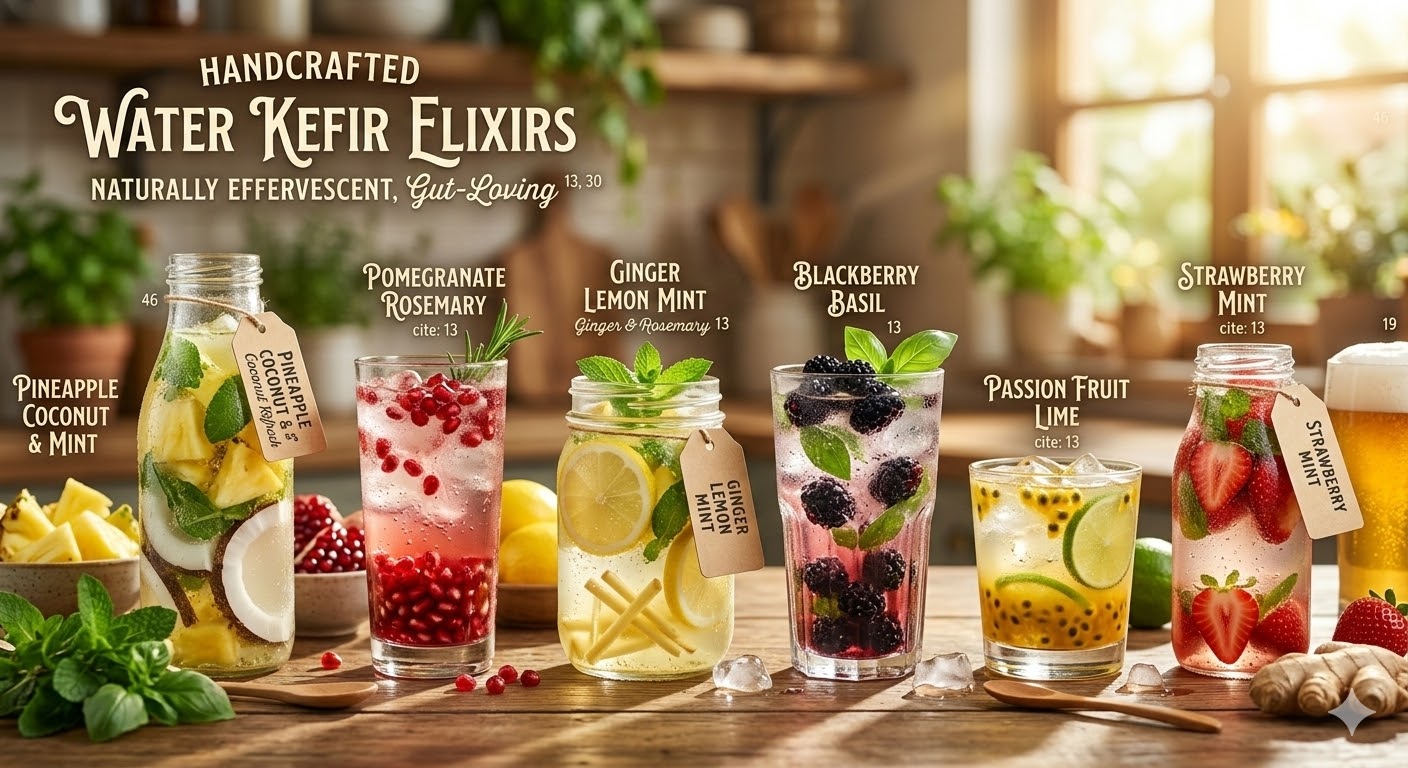
The single most rewarding thing you can do with finished water kefir is a 12-hour secondary fermentation with fresh fruit, ginger, or herbs. Pour the strained liquid into a sealed bottle, add about 10% by volume of your flavoring of choice, and let it sit at 20°C for 12–24 hours. The bubbles intensify; the new flavor steeps in; the drink develops in complexity.
Beyond the glass: water kefir as a versatile ingredient
- Probiotic vinaigrette: Use unflavored water kefir in place of vinegar in salad dressings
- Cocktail base: Replace tonic water in gin-and-tonic with ginger-flavored water kefir
- Sourdough starter feed: A small amount of water kefir boosts wild yeast activity in sourdough
- Smoothie booster: Blend a few tablespoons into morning smoothies for an instant probiotic dose
10. Food Pairings
Water kefir is one of the most food-friendly fermented drinks — its gentle acidity and clean carbonation cut richness without overpowering anything.
- Cuts richness: Pairs with Mediterranean grilled dishes or avocado salad — the organic acids effectively balance fat
- Cools spice: An excellent palate-cleanser for spicy Thai, Sichuan, or Indian meals
- Guilt-free brunch: Replace mimosas — pairs beautifully with eggs Benedict
- Post-workout recovery: Naturally rich in electrolytes and B vitamins — a clean recovery drink
- Dessert pairing: A ginger-lemon water kefir cuts the sweetness of rich cakes or chocolate desserts