1. Introduction
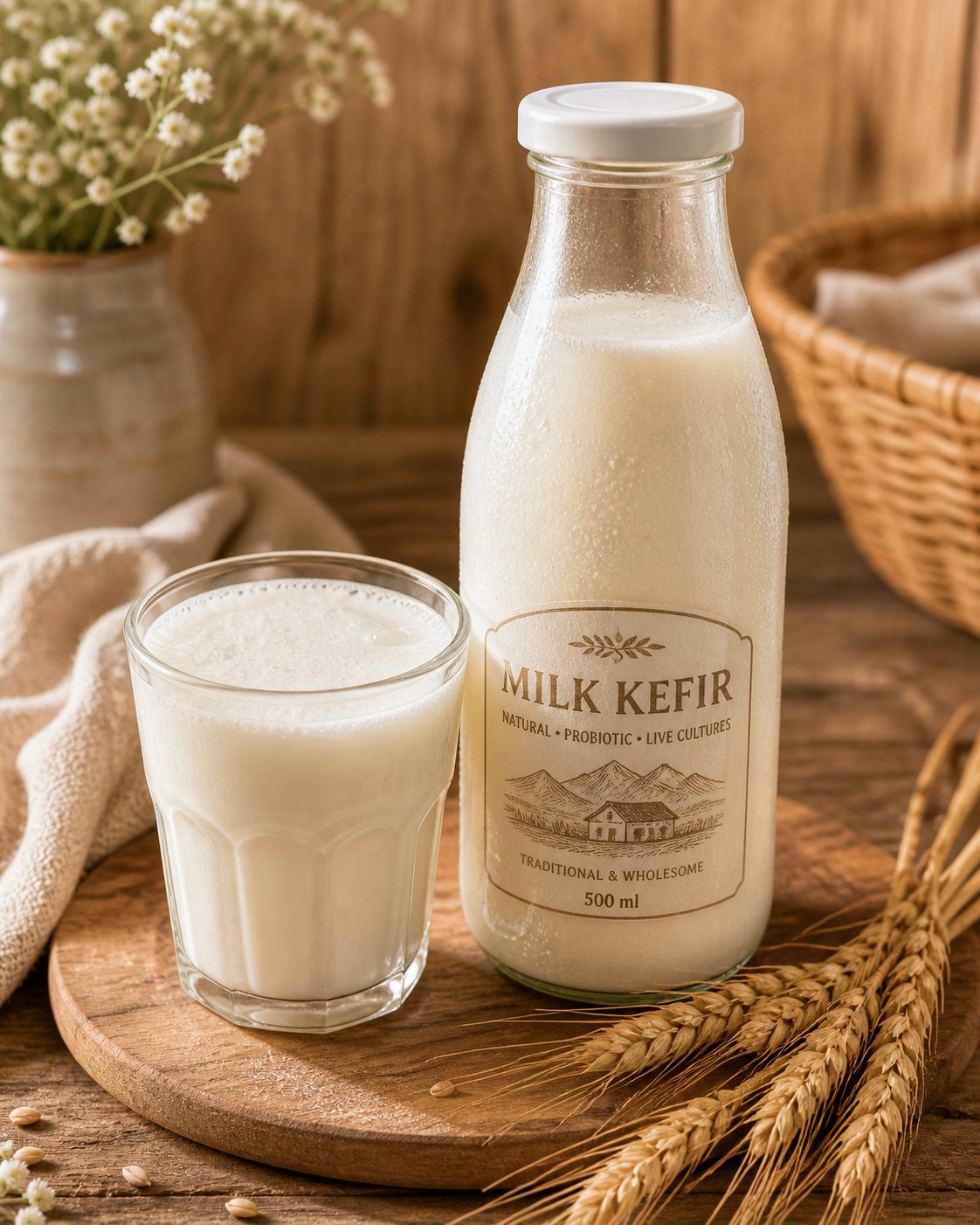
Milk kefir is an ancient fermented dairy drink from the Caucasus Mountains — sitting between milk and yogurt, yet exceeding both. Produced by the cooperative work of lactic acid bacteria and yeasts, it has a silky, slightly thick texture, a clean tartness, and a barely perceptible tingle of carbonation on the tongue. It belongs to that rare category of ferments that combine the refreshment of a beverage with the functionality of a probiotic.
It is a craft with an unusually low barrier to entry and an unusually deep ceiling: you can make a decent batch with a liter of milk and a sachet of culture in under 24 hours, or you can explore continuous brewing, secondary fermentation, and flavor variations until kefir becomes a living staple in your kitchen — a perpetual soup that anchors your daily routine.
This chapter takes you from the history of milk kefir to the practical process, from a basic recipe to advanced techniques. Read it once, and you will have a lifelong reference for milk kefir.
2. History and Cultural Background
The "Grains of the Prophet" from the Caucasus
The story of milk kefir begins among one of the world's most long-lived populations.
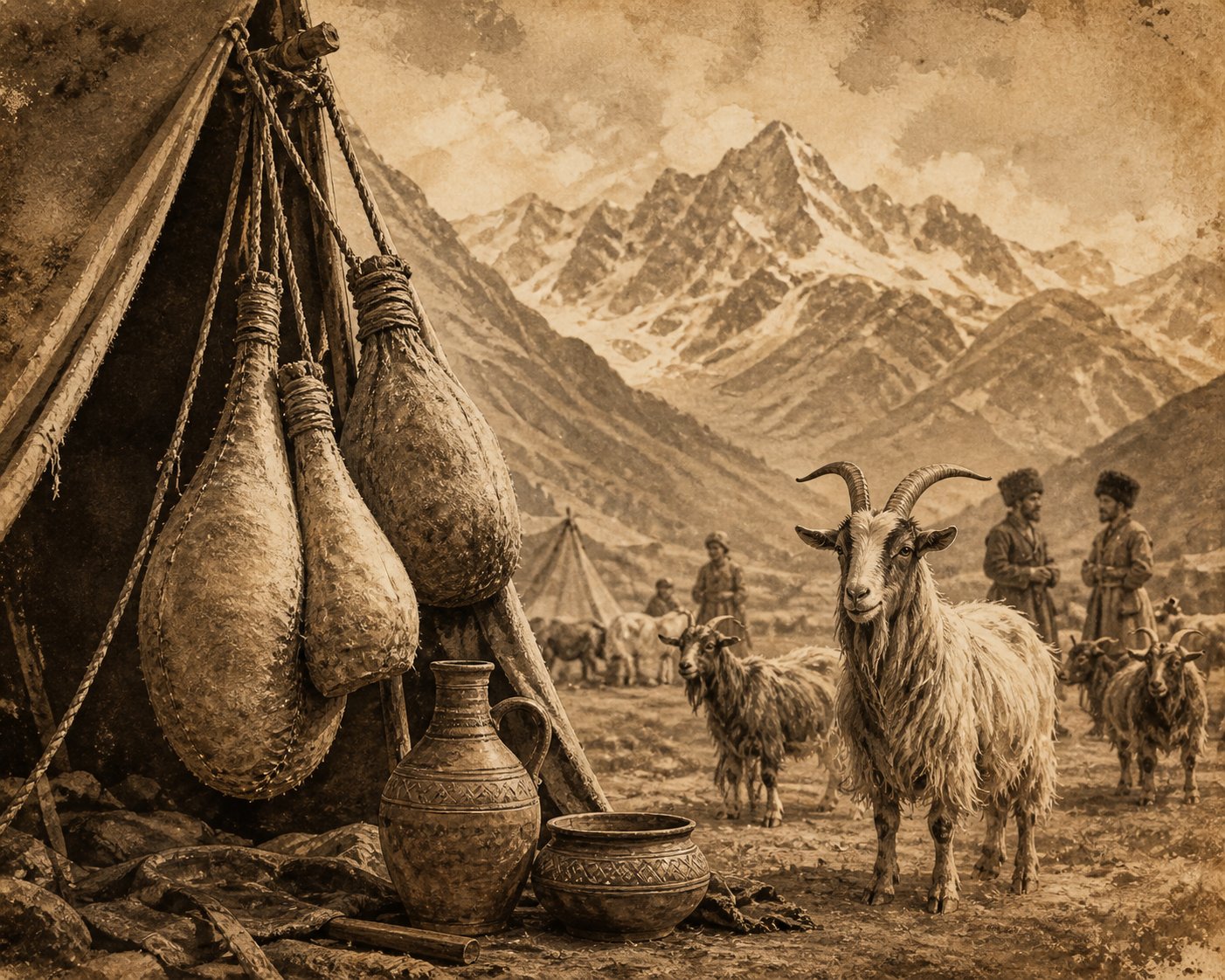
The Caucasus Mountains stretch between the Black Sea and the Caspian Sea — a landscape of steep terrain and shifting climate. The nomadic peoples who have lived there for millennia — the Karachay and Balkar peoples — kept goats and sheep as their livelihood, and milk was a daily staple. One day, someone carried fresh sheep's milk in a leather pouch for several days and discovered that it had thickened, turned slightly fizzy, and developed a clean tartness. The drink was unlike anything before, and gave the drinker an unusual sense of vitality. Milk kefir was born.
These first kefir grains became sacred to the local population, known as the "Grains of the Prophet" and held to be a gift from the Prophet Muhammad to the Caucasian peoples. The grains were treated as a family's most precious possession, passed down through generations and never sold or given to outsiders. To lose them was to lose divine favor — an omen of terrible misfortune. This protective mysticism kept kefir within the Caucasus for centuries.
The 1908 "Culture Heist"
The turning point came in 1908. The All-Russian Physicians' Society, determined to bring this rumored longevity drink into modern medicine, dispatched a young woman named Irina Sakharova to the Caucasus to obtain kefir grains. The mission was extraordinarily difficult — local tribal leaders refused to sell. Sakharova was briefly kidnapped, and only after diplomatic intervention by the Russian government was she released, departing with about 4.5 kilograms of kefir grains as restitution.
Those grains were brought to Moscow, opening the path to industrial kefir production. By the mid-twentieth century, milk kefir had become the Soviet Union's most popular daily beverage, served in hospitals, schools, and homes across the country — the unofficial national drink.
From Eastern Europe to the World: A Health-Drink Renaissance
After the Cold War, Eastern European immigrants brought kefir to Western Europe, North America, and Australia, where it gradually entered the global health-food conversation. The 2010s — and the rise of "gut health" as a mainstream nutrition topic — accelerated its adoption. Backed by thousands of years of history and a growing body of scientific evidence, milk kefir became, after yogurt, the most studied and consumed fermented dairy product in the world.
Today, the global milk kefir market exceeds one billion dollars. From commercial products on supermarket shelves to homemade jars in kitchen cupboards, kefir is reconnecting modern people with fermentation culture in ways unprecedented in its history.
3. Flavor Profile and Global Variations
Flavor profile
Milk kefir's flavor occupies a unique position — it is neither yogurt nor milk, but something between and beyond both.
- Texture: Thicker than milk, thinner than yogurt; a semi-flowing state with a silky, refined mouthfeel. Longer fermentation produces a denser, drinkable-yogurt-like consistency.
- Acidity: Lactic acid from the bacteria gives a clean, gentle tang — similar to good plain yogurt, but more refined and less aggressive.
- Effervescence: This is the single most distinctive feature versus yogurt. Yeast-produced CO₂ dissolved in the liquid creates a subtle "lift" on the palate — a soft, almost imperceptible tingle.
- Aroma: Carries the warm base notes of fresh milk, with a soft fermented overtone reminiscent of natural cheese — never artificially sweet.
- Finish: A whisper of yeast, with a faint bread-like aftertaste — the signature of the SCOBY-like culture that both milk kefir and water kefir share.
Global variations
| Region | Style and tradition |
|---|---|
| Russia, Eastern Europe | Drunk straight, paired with black bread, or used as a soup base; traditionally consumed after dinner as a digestive. |
| Caucasus | The original; sheep or goat's milk versions are more common, producing thicker, more acidic kefir. |
| Poland | Known simply as "kefir"; a breakfast staple, often paired with fruit or oats. |
| Israel | Widespread in health-conscious food culture; low-fat versions are particularly popular. |
| North America, UK | Recent revival as a "gut health drink," now standard in organic grocery stores. |
| Australia | Penetrated craft fermentation culture; home-made kefir has become part of the modern healthy-living identity. |
4. Characteristics
Flavor and mouthfeel
Milk kefir occupies a uniquely useful spot on the beverage spectrum — lighter than yogurt, more interesting than milk, gentler than kombucha, more nutritive than beer. This "middle ground" position means it has almost no direct competitor among functional drinks. It works as a standalone breakfast, a baking liquid, a salad dressing base, and a smoothie foundation.
Health benefits
Milk kefir is among the most extensively studied fermented dairy products. The scientific literature documents the following benefits:
- Probiotic diversity: A typical batch of milk kefir contains 30–56+ probiotic strains, far exceeding the 2–5 strains in commercial yogurts. This diversity is considered important for maintaining gut microbiome balance.
- Lactose digestion: Fermentation breaks down most of the lactose, allowing many lactose-intolerant individuals to access the calcium and protein in milk that they would otherwise have to forgo.
- Bone density support: Rich in calcium, phosphorus, and vitamin K2. Multiple studies suggest that regular consumption helps maintain bone density, with particular significance for older adults.
- Immune modulation: The gut is the body's largest immune organ; adequate probiotic intake is closely linked with immune regulation. Kefiran, the polysaccharide unique to kefir cultures, has shown preliminary evidence of immunomodulatory activity.
- Anti-inflammatory potential: Some laboratory and animal studies indicate kefir ferments suppress certain inflammatory markers, though human clinical trial data is still being accumulated.
Cautions
- Start gradually: When first introducing probiotics, your gut microbiome is adjusting, and mild bloating during this period is normal. Begin with 50–100 ml per day and work your way up to 200–300 ml as your gut adapts.
- Lactose intolerance: Fully fermented kefir (24+ hours) has substantially reduced lactose, and most mildly lactose-intolerant people tolerate it well. Severely intolerant individuals should test small quantities first, or opt for secondary-fermented versions, which reduce lactose further.
- Sensitive populations: Those with severely compromised immune systems, newborns, or pregnant women should consult a doctor before consuming home-fermented kefir.
- Not a medical treatment: Kefir is a fermented food, not a medical treatment. The content here is for educational purposes and does not constitute medical advice. Consult a professional for specific health concerns.
5. Ingredients
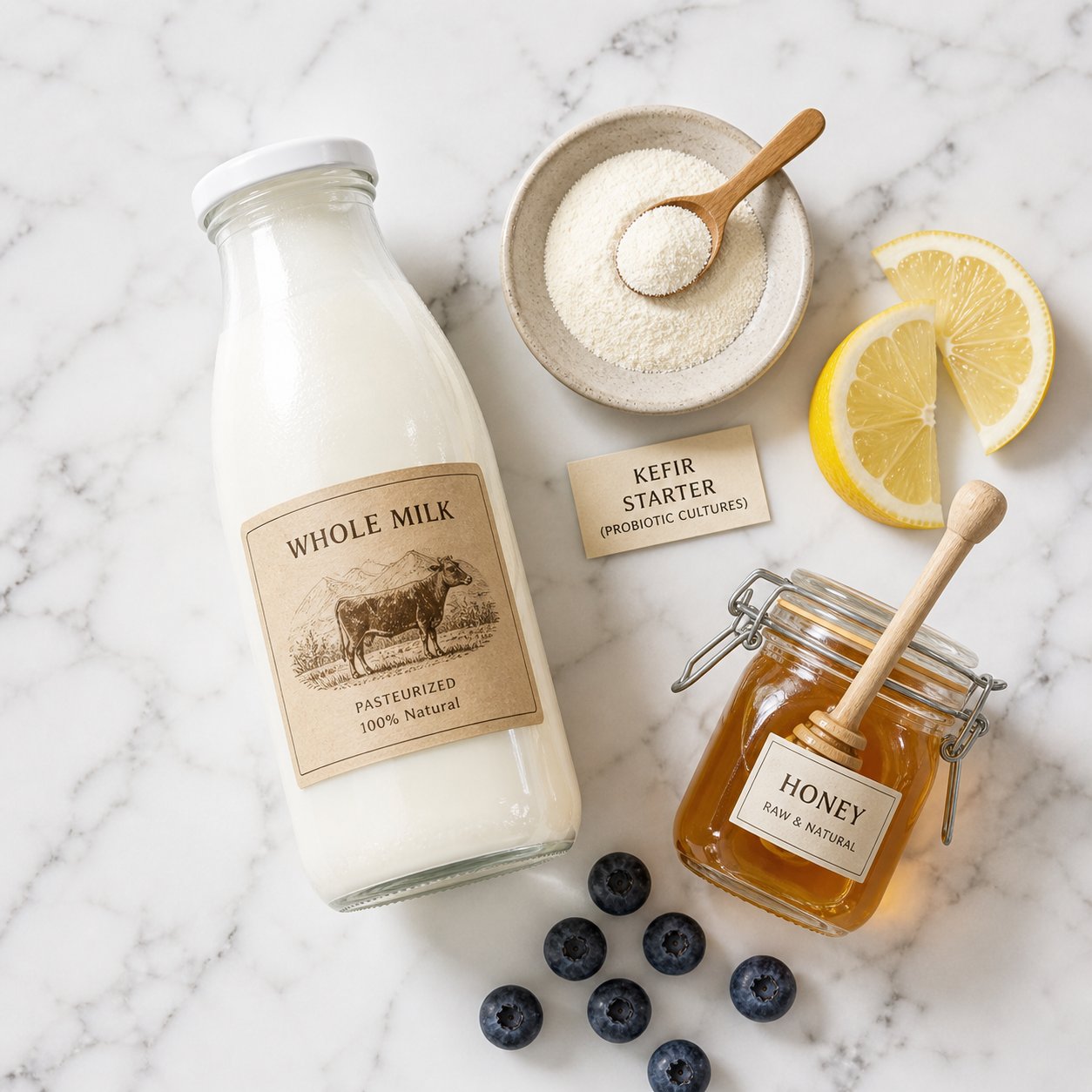
The following recipe produces about 1 liter of finished milk kefir — enough for daily drinking or as a base for further creations.
Primary ingredients
| Ingredient | Amount | Notes |
|---|---|---|
| Milk (see selection guide below) | 1 liter | Whole, low-fat, or skim; fat content affects finished thickness |
| Milk kefir culture powder | Per package directions | Standardized freeze-dried culture; convenient to use, no grain maintenance required |
Milk selection: fat content and finished texture
Choosing the right milk is the first decision in your kefir. Different fat levels produce noticeably different results:
| Milk type | Fat % | Thickness | Mouthfeel | Best for |
|---|---|---|---|---|
| Whole milk | ≥3.5% | ★★★★★ Thick | Rich and silky, prominent milk aroma; resembles drinkable yogurt | Drinking neat, smoothies, baking |
| Low-fat milk | 1–2% | ★★★☆☆ Medium | Balanced; more pronounced acidity, good fluidity | Daily drinking, salad dressings |
| Skim milk | <0.5% | ★★☆☆☆ Thin | Lightest; acidic and thin in body | Low-calorie recipes, mixing into smoothies |
For first-time brewers, whole milk is recommended. It produces the texture and flavor closest to traditional kefir and is the most forgiving to small inconsistencies in process.
Optional flavoring ingredients (for finished kefir)
| Ingredient | Amount | Flavor effect |
|---|---|---|
| Natural vanilla extract | A few drops | Adds vanilla-milk aroma, ideal for drinkable formats |
| Honey or maple syrup | 1–2 tsp | Balances acidity, adds rounded sweetness |
| Fresh blueberries or strawberries | To taste | Add during secondary fermentation for fruit aroma and a soft pink hue |
| Cinnamon powder | A pinch | Warm autumn/winter formula, pairs especially well with honey |
| Turmeric powder | ¼ tsp | Anti-inflammatory formula, more effective when paired with black pepper |
6. Process
Equipment
- A fermentation vessel of 1 liter or larger (food-grade, sealable)
- A small pot (if boiling raw milk)
- A thermometer (to confirm milk temperature before adding culture)
- A silicone or wooden spoon
- A temperature-controlled environment maintaining 24°C (a proofing box, heating mat, room-temperature cupboard, or a fermentation device)
Step 1: Select and prepare your milk
The way you prepare your milk determines both fermentation safety and the flavor baseline. Choose the option that matches your milk type:
Option A — Raw milk (boiling recommended)
Raw milk may contain environmental bacteria. To ensure clean fermentation, heat the milk to a boil for 1–2 minutes, then turn off the heat and let it cool naturally to below 35°C before adding culture. Boiling removes competing microbes, allowing the kefir culture to ferment cleanly.
If your kitchen environment is clean and your handling is sanitary, you can heat raw milk directly to 35°C and skip the boiling step.
Option B — Pasteurized milk (use as-is)
Pasteurized milk has already been low-temperature sterilized; the risk of contamination is minimal, and it can be used directly. After removing from refrigeration, either let it warm to room temperature (~25°C) or gently heat to 30–35°C, then add culture. No boiling needed.
Temperature warning: Whichever milk you use, the temperature must be below 38°C when you add the culture. Higher temperatures damage the bacteria and compromise fermentation.
Step 2: Add the culture
Per the package directions, add the culture powder directly to your prepared milk and stir gently with a silicone spoon for 1–2 minutes until fully dissolved.
Culture powder is significantly easier to use than traditional kefir grains — no activation period, no daily feeding. Just dose and go.
Step 3: Vessel and fermentation setup
Transfer the milk-and-culture mixture to your fermentation vessel and seal it tightly. Milk kefir produces limited pressure during fermentation, so sealed fermentation is safe and helps retain some CO₂, giving the finished kefir a livelier effervescence.
Place the sealed vessel in your temperature-controlled environment with the following parameters:
- Temperature: 24°C
- Fermentation time: 18–48 hours
24°C is the optimal fermentation temperature for milk kefir. Significant ambient temperature variation (summer above 30°C or winter below 18°C) will noticeably affect fermentation rate and texture. A controlled environment eliminates this uncertainty entirely.
Fermentation time vs. texture:
| Time | Thickness | Acidity | Lactose remaining | Best for |
|---|---|---|---|---|
| 18 hours | ★★☆☆☆ Thin | Gentle, slightly sweet | Higher | First-time brewers, sweet preferences |
| 24 hours | ★★★☆☆ Medium | Balanced, harmonious | Medium | The daily default for most people |
| 36 hours | ★★★★☆ Thick | Pronounced, layered | Lower | Yogurt-texture preferences, lactose-sensitive drinkers |
| 48 hours | ★★★★★ Very thick | Strong, Greek-yogurt-like | Minimal | Heavy fermentation enthusiasts, as a thick base |
As fermentation time extends, lactic acid bacteria continue converting lactose into lactic acid. Thickness increases, acidity sharpens, and lactose content drops. Find the time point you prefer, then reproduce it batch after batch.
Step 4: Observe fermentation status
About 2 hours before estimated completion, you can gently tilt the vessel to observe its state:
| Observation | Meaning |
|---|---|
| Visibly thickened, slow flow when tilted | Fermentation progressing well |
| Small amount of whey separating at the bottom (translucent yellow liquid) | Near completion, balanced acidity |
| Clean tart aroma, like natural yogurt | Optimal harvest window |
| Heavy whey separation, overly sour taste | Over-fermented; shorten by 1–2 hours next batch |
Step 5: Refrigeration and consumption
After fermentation, transfer the kefir to refrigeration. Cold storage refreshes the flavor and slows microbial activity, keeping the kefir stable for 3–5 days.
Refrigerated kefir continues to thicken slightly — this is normal.
Step 6: Continuous brewing — a kefir that never runs out
Milk kefir has a delightful property: it can run as a perpetual soup, producing continuously without restarting each batch. This method, traditional in Caucasian households, is called continuous fermentation.
How it works
Finished kefir still contains active culture. When you've consumed some, the remaining kefir itself becomes the starter for the next batch — already cultured, already active. Just top up with fresh milk and the next cycle begins quickly. No need to add fresh culture powder.
Why continuous brewing is faster than the first batch
After several rounds of fermentation, the residual culture in the vessel has grown into a much denser, more active population than the freshly-rehydrated powder you started with. This is why subsequent rounds are dramatically shorter — typically around 12 hours instead of 18–24 hours. The culture is mature and ready to work.
Procedure
① Drink down to roughly 1/5 of the vessel. When the kefir in the vessel is about one-fifth left, you're ready to continue. Don't drain it completely — that remaining 1/5 is your concentrated starter for the next batch. Smaller leftover proportions also work, but 1/5 is the sweet spot — it gives enough active culture to quickly start the next batch without making the next round overly acidic.
② Top up with fresh milk. Pour fresh milk back into the vessel up to its original capacity. Raw milk should be cooled to below 35°C first; pasteurized milk can go in directly. Stir gently to integrate the remaining culture with the new milk.
③ Restart fermentation. Reseal the vessel and return it to the 24°C environment for about 12 hours. Because there's already a large active culture starting the batch, this round usually completes much faster than the first round — and you'll see thickening and tartness develop noticeably sooner.
④ Continue indefinitely. Repeat the cycle. After each session of drinking, top up with fresh milk, and your kefir can stay in continuous production.
If your continuous-brew kefir gets too tart
After several cycles, the accumulated culture can produce noticeably sharper acidity than the first round. This is a natural consequence of the increased culture density and is not a sign of failure. Two ways to balance:
- Stir in honey — 1–2 teaspoons per glass softens the acidity and adds rounded sweetness without affecting the live cultures. Honey is the classical pairing in Eastern European tradition.
- Mix in fruit juice — fresh-squeezed apple, pear, or berry juice can be stirred into a glass of kefir at a 1:3 to 1:2 ratio (juice to kefir). This not only balances the tartness but also turns the kefir into a quick smoothie-style drink.
You can also reset the cycle entirely (see below) if the acidity has drifted further than you want.
Cautions for continuous brewing
- After 5–7 cycles, fully clean the vessel and restart from fresh culture powder. Even healthy continuous-brewed cultures accumulate variation over time, and a periodic reset prevents contamination buildup or flavor drift.
- If any batch develops off-flavors, abnormal color (pink or orange), or excessive separation, stop the continuous fermentation immediately, clean the vessel thoroughly, and restart from fresh culture.
- Each cycle's flavor varies slightly — this is the charm of hand-fermented kefir, not a defect.
7. iGulu Settings
This section provides specific parameters for users brewing milk kefir on the iGulu device. If you're using traditional equipment, you can skip this section — the previous section ("Process") covers the general workflow.

How milk kefir works on iGulu
The iGulu device maintains 24°C throughout fermentation and automatically switches to Sparkling Mode (chilled storage with controlled CO₂ pressure) once fermentation completes. The setup for milk kefir is the same as the general process described in Section 6 — the device handles temperature and timing in the background.
Recommended parameters
| Mode | Parameters | Notes |
|---|---|---|
| Primary fermentation | Temp 24°C / Time 18–48 hours | Longer = thicker, more acidic, less lactose. Choose the time point matching your preference |
| Continuous brewing | Temp 24°C / Time ~12 hours | After drinking down to 1/5, top up with fresh milk; the residual active culture starts the next batch quickly |
| Secondary fermentation | Temp 24°C / Time 6–8 hours | Add flavorings and seal for short fermentation; livelier carbonation, more integrated flavor |
| Sparkling Mode | Temp 2–4°C / Pressure 10–15 psi | Activates automatically after fermentation; chilled pressure dissolves CO₂ into the kefir |
Sparkling Mode explained
After fermentation completes, iGulu automatically switches into Sparkling Mode: temperature drops to 2–4°C, and CO₂ slowly dissolves into the kefir under 10–15 psi pressure.
Milk kefir is too thick to produce visible bubbles like soda or beer. What Sparkling Mode does is subtler — the dissolved CO₂ creates a barely-there liveliness on the tongue. The dense mouthfeel feels lighter, the finish less heavy. It's a small but real improvement to the kefir-drinking experience.
After entering Sparkling Mode, let the kefir rest at least 2 hours before opening. Open slowly to release pressure gradually — thick liquids can expand suddenly when uncapped fast.
Culture powder for iGulu
The milk kefir culture powder included with iGulu is standardized freeze-dried live cultures, requiring no daily maintenance.
- Storage: Keep unopened powder in a cool, dry place (or refrigerated), away from heat and direct sunlight. After opening, seal tightly and use within a reasonable period to prevent moisture exposure.
- Per-batch dose: Add the amount specified on the package, typically one standardized unit per liter of milk. Adding more does not improve quality but may speed up fermentation excessively, resulting in over-acidity.
- Difference from traditional kefir grains: Traditional milk kefir grains are a live SCOBY that requires feeding fresh milk every 1–2 days to maintain activity. The freeze-dried culture preserves live cultures without the maintenance burden — ready to use, no activation required.
Drinking your iGulu kefir
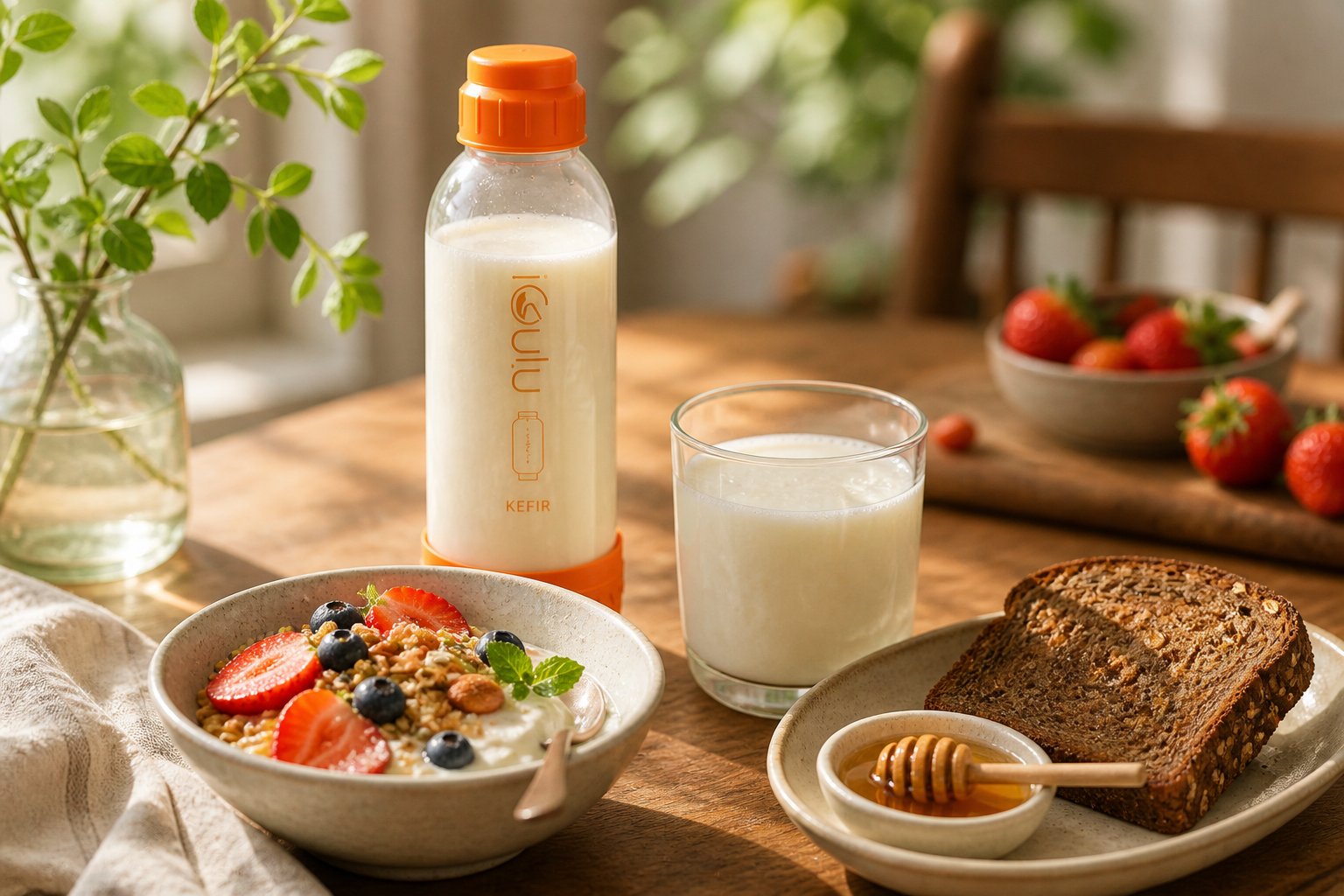
Pour directly from the iGulu tap into a glass. The kefir pours thick and slightly effervescent, ready to pair with breakfast or be used as a base for variations.
8. FAQ
Q: My grains have turned yellowish — is this normal?
A: A light cream color is within normal range. If grains turn orange, pink, or develop an off odor, this typically indicates contamination — discard and obtain fresh grains.
Q: There's a thin film on the surface after fermentation. What is it?
A: This is the polysaccharide film secreted by kefir cultures. It's normal — stir it in and drink.
Q: I felt bloated after drinking kefir. What should I do?
A: When introducing probiotics for the first time in significant quantities, your gut microbiome is adjusting, and mild bloating is a normal detox-like response. Start with 50–100 ml per day and gradually work up to 200–300 ml as your gut adapts.
Q: I'm lactose intolerant. Can I still drink milk kefir?
A: Likely yes. During fermentation, lactic acid bacteria convert most lactose into lactic acid. After full fermentation (24+ hours), lactose content is substantially reduced, and most mildly lactose-intolerant people tolerate it well. Secondary fermentation reduces lactose further.
Q: My continuous-brewed kefir is too sour. Did I do something wrong?
A: No — this is normal. As you continue brewing, the residual culture grows denser, producing more lactic acid per cycle. You have three options: drink it as-is with a teaspoon of honey stirred in, mix with fresh fruit juice (apple or berry), or reset by cleaning the vessel and starting with fresh culture powder.
9. Variations and DIY
Secondary fermentation (the easiest flavor upgrade)
If you want more effervescence and flavor complexity, you can run a secondary fermentation after the primary: add your chosen flavorings (fresh fruit, honey, etc.), reseal, and ferment another 6–8 hours at room temperature or in your fermenter at 24°C.
Secondary fermentation produces more pronounced effervescence, integrates fruit aromas with acidity, and further reduces lactose — making it more forgiving for lactose-sensitive drinkers. After completion, refrigerate; optimal drinking window is 3–5 days.
Beyond the glass: kefir as a versatile ingredient
Milk kefir isn't just a drink — it's a versatile fermentation base with broad applications:
- Drink it straight: Refrigerated, with honey and blueberries — a perfect breakfast drink.
- Smoothie base: Substitute for regular yogurt; richer flavor, higher probiotic content. Blueberry + banana + kefir is the classic combination.
- Baking: Replace yogurt or buttermilk in muffins, pancakes, or bread. Produces a softer texture and more layered flavor.
- Dressing base: Make tzatziki or ranch dressing with kefir instead of yogurt; smoother mouthfeel, more natural acidity.
- Overnight oats: Soak oats in kefir overnight. The oats absorb the liquid and soften, becoming slightly tart and tender — an excellent healthy breakfast.
10. Food Pairings
| Kefir style | Pairing | Occasion |
|---|---|---|
| Plain (gentle tartness) | Rye bread + smoked salmon | Eastern European breakfast tradition |
| Honey & vanilla | Granola + fresh strawberries | Refreshing breakfast, summer-appropriate |
| Turmeric & black pepper | Grilled chicken salad | Functional lunch, anti-inflammatory pairing |
| Blueberry secondary-fermented | Banana + oats | Post-workout recovery drink |
| Rich whole-milk version | Blueberries + honey + oats | The perfect breakfast bowl |