1. Introduction
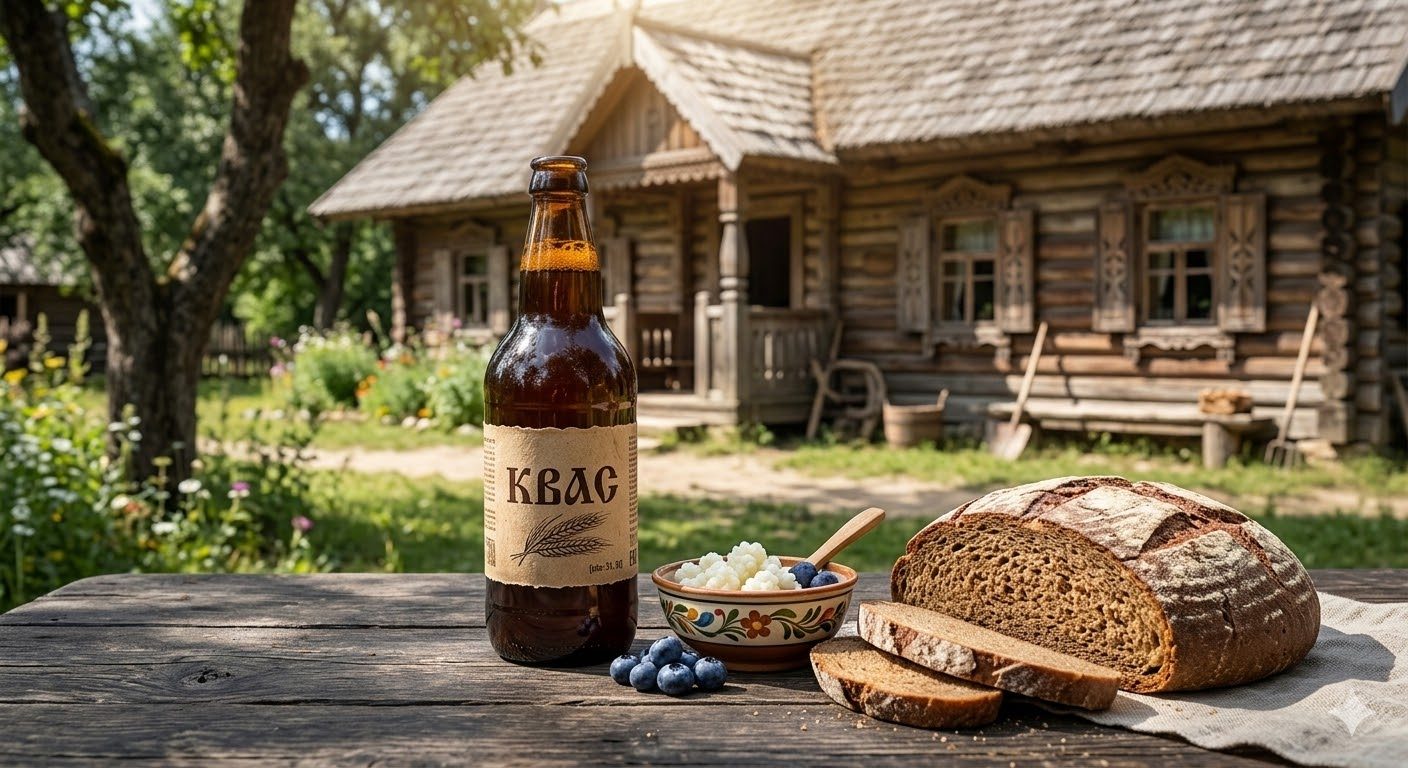
Kvass is a low-alcohol (typically 0.5–1.5%), lightly sparkling fermented drink made from bread — most often dark rye, toasted to a deep brown. It's the kind of drink that begins as something humble: stale bread, a little sugar, a few raisins, two days. What comes out is amber-colored, gently sour, mildly fizzy, and surprisingly complex — somewhere between a soft beer, a sourdough loaf, and a sparkling cider.
This chapter walks through the Slavic origins of kvass, the bread-and-yeast biology behind it, the iGulu-validated brewing parameters for a 4 L batch, and a series of variations (including the deep, herbal spiced beet kvass) for those who want to go beyond the classic.
Turning yesterday's bread into today's sparkling drink may be the cleverest piece of food reuse in human history.
2. History and Cultural Background
A culinary tradition born of a stale loaf
Kvass begins with a hardened slice of dark rye bread. In the wood-walled kitchens of medieval Slavic peasants, bread did not get thrown out — it kept ageing. After two or three days it would become too tough to chew, but it would not be discarded. Pour over boiling water, add a bit of sugar and a few raisins, set aside for two days — and that pile of stale bread becomes a low-alcohol, lightly sparkling, deeply hydrating fermented drink.
Russians call it Квас (Kvass), Ukrainians the same, Poles say Kwas chlebowy (literally "bread sour-liquid"), Lithuanians say Gira. Across the Slavic world, almost every household once had a barrel of it standing in the cellar.
The street drink of the Slavic summer
In the height of summer, on the streets of Moscow, Kyiv, and Warsaw, kvass vendors push tank-shaped carts and pour the cool, amber drink into cups for kopecks. For Slavic children, kvass is the first drink of memory — the way Coca-Cola is for some American kids. It is the drink of family gatherings, of harvest festivals, of summer thirst, of cold okroshka soup at the kitchen table.
From regional secret to global revival
While soda spread across the world, kvass remained a regional secret. Outside Eastern Europe, no one ever really knew what it tasted like. Until recently — at artisan ferment markets in Brooklyn and Berlin, kvass began appearing under the label of "the bread version of kombucha." This Eastern European farmhouse drink, after centuries in one corner of the world, has begun finding new fans everywhere.
The interest is more than nostalgia. As probiotic awareness has grown, kvass's profile has shifted: from "what grandmother drank" to "a living, probiotic, low-sugar alternative to soda" — and the kind of drink that is dead simple to brew at home.
3. Flavor Profile and Global Variations
Flavor profile
First-timers usually have an interesting reaction: they expect something like a sweet soda, and get something completely different — bread aroma, mild tartness, fine bubbles, a long finish.
On the entry: light bubbles land first, followed by the toasted-grain aroma of the bread — the imprint of the Maillard reaction. Caramelized but not bitter.
The mid-palate: the gentle acidity of lactic acid arrives — not the sharp acid of lemon, more like the lingering tang of a natural sourdough loaf. The residual sugar provides a soft sweetness; sweet and sour reach a balance.
The finish: rye's nutty, cereal notes spread slowly across the back of the throat — long, plain, unpretentious. Good kvass is complex and alive, not a sugary soda.
Global variations
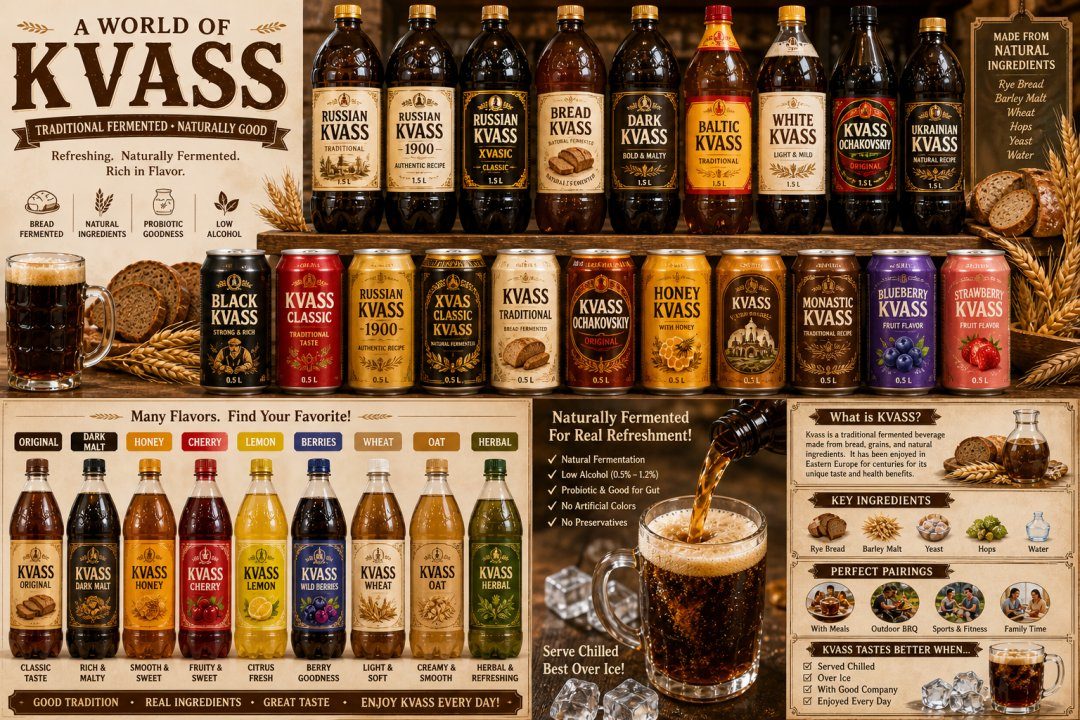
Kvass spread out of Eastern Europe and picked up a new name in every kitchen it reached. The names change but the underlying logic doesn't: turn grain or bread into a drink. That impulse is nearly universal in human civilization.
4. Characteristics
Flavor and mouthfeel
- Color: Deep amber to dark brown (depending on bread toasting and rye proportion)
- Aroma: Toasted bread, caramel, faint malt, mild sourdough tang
- Mouthfeel: Fine, lively carbonation; gentle acidity; soft residual sweetness
- Alcohol: Typically 0.5–1.5% in standard fermentation — comparable to fruit juice
- Finish: Long, slightly nutty, cereal-driven; not sticky-sweet
Health benefits
Kvass is a low-alcohol drink produced by fermenting bread (or grain). The science is simple — two microbes do the work in collaboration.
Lactic acid bacteria (Lactobacillus) convert the sugars in the bread into lactic acid, which gives kvass its gentle, mellow tartness and is the core of its "aliveness." Yeasts produce CO₂ and a small amount of alcohol — the source of bubbles and the more layered notes. This two-microbe system is nearly identical to the fermentation behind natural sourdough — so to drink kvass is, in a sense, to drink a living glass of sourdough.
What's actually in a glass of fresh, hand-brewed kvass:
- Live lactic acid bacteria — direct support for gut microbiota and digestion
- B vitamins (B1, B2, B6) — byproducts of rye fermentation, good for nerves and metabolism
- Soluble dietary fiber — rye is rich in β-glucans, which become more bioavailable after fermentation
- A small amount of amino acids — from the breakdown of bread protein during fermentation
Cautions
⚠️ Any bottled kvass you buy in a supermarket has been heat-pasteurized — all the live microbes are dead. Only fresh, home-brewed, unpasteurized kvass is truly a probiotic drink.
- Kvass contains gluten (it's made from bread); not suitable for celiac diets
- Alcohol typically 0.5–1.5% — low, but not zero; not suitable for drivers immediately before driving, or for very young children
- Store finished bottles in the fridge; warm-stored kvass continues to ferment and can crack bottles
- A faint sour smell is normal; sharp, rotten, or sulfurous smells mean discard the batch
5. Ingredients
The following is the iGulu standard recipe — yields about 4 liters of finished kvass.
Primary ingredients
| Ingredient | Quantity | Notes |
|---|---|---|
| Rye bread (or dark sourdough) | 400–500 g | Stale and hard is ideal; fresh bread must be toasted to dark brown first |
| Filtered water | 4.5 L | Filtered or tap water rested 24 hours |
| White sugar or malt syrup | 100–150 g | First-timers, start with 120 g |
| Dried yeast (bread yeast or white-wine yeast) | 4–6 g | Don't overdo it — too much yeast and alcohol will overpower the bread aroma |
6. Process
Equipment
- A large pot (5 L or more)
- Fine cheesecloth or cotton cloth (for filtering bread debris)
- iGulu fermentation vessel (4 L batch)
- Sealed glass bottles or food-grade plastic bottles (for secondary fermentation and storage)
Step 1: Toast the bread — the soul of kvass
Slice the rye bread into pieces about 1–2 cm thick, lay them flat on a baking tray, and bake at 180°C for 15–20 minutes — until the surface is deep brown and the edges are lightly charred.
The high heat triggers the Maillard reaction in the bread — this is the origin of kvass's signature toasted-malt aroma and deep amber color. The darker you toast, the darker the color and the more pronounced the toasted character.
Step 2: Infusion — patience is the best ingredient
Place the toasted bread slices into the large pot, pour over 3.5 L of just-boiled water, press the bread into the water with a spoon, and stir to combine. Cover the pot and let it sit at room temperature for 4 to 8 hours.
Step 3: Filter and dose
Set the cheesecloth over a large bowl or pot and pour the infused bread liquid through. Press the soaked bread firmly with hand or spoon to squeeze every drop out — that's all good stuff, don't waste it.
After filtering, stir in the sugar (or honey) until fully dissolved, then add your chosen adjuncts (mint, raisins, lemon, etc.). Pour the entire mixture into the iGulu fermentation vessel.
Step 4: Pitch the yeast and ferment
Once the liquid has cooled to about 25°C (cool to the touch — important, hot liquid kills yeast), sprinkle the dried yeast over the surface, stir gently to disperse, and seal the iGulu vessel.
In the iGulu app: Primary fermentation temperature: 25°C | Primary fermentation time: 24–30 hours
Step 5: Bottle and second ferment
Once the primary ferment finishes, transfer the liquid to sealed bottles (leave 3–4 cm of headspace) and place them back in iGulu: Secondary fermentation temperature: 20°C | Secondary fermentation time: 12–18 hours
This is where the bubbles develop. Don't overfill — pressure build-up can crack a bottle.
Step 6: Chill and drink
After the second ferment, move the bottles to the fridge to slow fermentation. Best served at 3–5°C, chilled.
7. iGulu Settings
How kvass works on iGulu
Kvass's lactic bacteria love a stable environment. Room-temperature brewing gives unpredictable results; iGulu holds temperature year-round, and the same recipe delivers the same drink every time.
Four iGulu advantages for kvass:
- Steady temperature: Kvass is sensitive to ambient swings. iGulu holds temperature year-round, batch after batch.
- Sealed, oxygen-free: Kvass is sensitive to oxygen later in the ferment. Too much air exposure and the fresh-baked aroma oxidizes away. iGulu's sealed chamber locks in that just-baked smell.
- App monitoring: Real-time fermentation progress — know exactly when to bottle. No more guessing.
- Right-sized batches: 4 L is the ideal home-brew size for kvass — enough for a family to drink through three to five summer days, always fresh.
8. FAQ
Q: My kvass tastes too yeasty / alcoholic. What went wrong?
A: Too much yeast, or fermentation went too long. Cut yeast to 4 g for a 4 L batch and keep primary fermentation under 30 hours.
Q: It's not fizzy enough.
A: Either secondary fermentation was too short, or the bottles weren't sealed tight enough during secondary. Push secondary to 18 hours and check seals.
Q: Can I use any kind of bread?
A: Rye and dark sourdough work best. Wheat bread will work but produces a lighter, less characterful drink — compensate by toasting much darker.
Q: How long does finished kvass keep?
A: 7–10 days in the fridge at peak flavor. Beyond that the acidity climbs and the bubbles fade. Best to brew small batches and drink fresh.
9. Variations and DIY
🌿 Mint-lemon kvass — the summer pick
Add 15 g of fresh mint leaves and 3–4 lemon slices to the filtered bread liquor, infuse for 30 minutes, then pitch the yeast. The result is cool and translucent, with bubbles that hit the tongue with a mint chill. Beats anything else at a summer BBQ.
🫐 Red-berry kvass — the looker
Ferment with 150 g of blackcurrants, blueberries, or a frozen mixed-berry blend. The fructose in the berries makes the ferment more lively and produces more bubbles; the finished drink is a deep purple-red, with the sweet-tart fruit aroma woven into the toasted-bread base. Pour this for guests — the atmosphere shifts immediately.
Advanced variant: spiced beet kvass
If bread kvass is the everyday Eastern European kitchen, beet kvass is its older, more mysterious cousin. The base is not bread but fresh beetroot, fermented directly. The color is deep ruby — almost like a diluted red wine. The flavor is more sour, more "earthy" than bread kvass — that mineral, soil-deep aroma from the beetroot.
10. Food Pairings
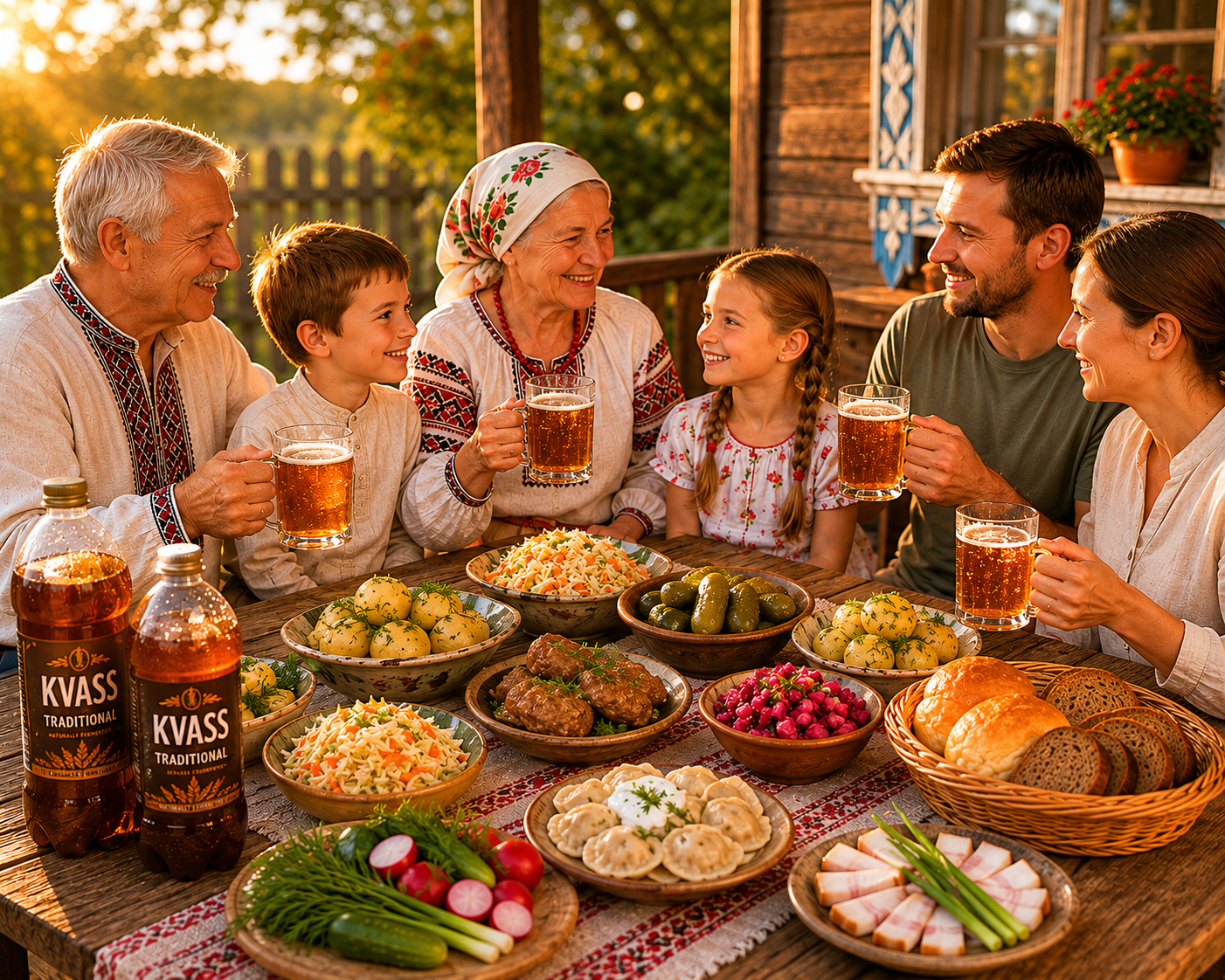
Kvass is best at 3–5°C, served chilled. It's a mealtime drink — pour, lift, drink. That's the right way to approach it.
- With grilled and smoked meats: kvass's lactic acid is the enemy of fat — first-rate at cutting richness. Keep a chilled jug nearby at a summer BBQ; refreshing as beer, no risk of getting drunk.
- With pickles and salt-cured snacks: ferment meets ferment — the salty-sour of pickles and the mild tang of kvass overlap on the palate in a strange and wonderful umami resonance.
- With rye bread and cheese: a bread-based drink with bread — Slavic simplicity at its most perfect. A hard cheese, a slice of rye bread, a glass of kvass — simple but deeply satisfying lunch.
- As a base for cold soup (okroshka): the traditional Russian summer cold soup, built on kvass — with cucumber, radish, boiled egg, ham, and sour cream. Sounds strange, tastes cold and tangy and clean — true survival food for hot days. Worth trying at least once.
For those cutting back on alcohol, kvass is a worthwhile alternative to kombucha: 0.5–1.5% ABV, comparable to fruit juice, but with a flavor more complex than any non-alcoholic drink and a real probiotic payload. Best of all, it's nearly the lowest-barrier ferment to make at home — the ingredients are bread and water, the time is two days, iGulu handles the details. Your job: toast some bread, wait for the ferment, open the bottle.
Stale bread is a waste to throw out. Brew it into a batch of good kvass instead.