1. Introduction
Porter is the original dark beer — the style that taught London how to drink, gave 18th-century brewers the first industrialized brewery, and seeded an entire family tree of dark ales that today includes Stout, Imperial Porter, and the Baltic Porter. A well-made Porter sits in the glass with the color of a strong cup of coffee, throws an aroma of chocolate and toasted bread, and finishes dry and clean — never the sweet syrupy heaviness people sometimes expect from "dark beer."
This is also the most forgiving dark beer for a home brewer to learn on. The grain bill is uncomplicated, the fermentation is a standard ale ferment, and the style tolerates a wide range of execution — a Porter that goes slightly off-target is still a Porter, where the same drift would ruin a delicate Pilsner.
This chapter treats Porter as an umbrella style. The base recipe and brewing process below are written around the American Porter — the most accessible sub-style for a first build and the most internationally available ingredient set. The full range — English, American, Baltic, Robust, Smoked, Imperial — is covered in Section 9 (Variations).
2. History and Cultural Background
London, 1720s: the brown beer that ate the city
The traditional story — repeated in beer books for two centuries — credits a single London brewer, Ralph Harwood of the Bell Brewhouse in Shoreditch (c. 1722), with inventing Porter by mixing three different ales ("three threads") into one cask and calling it "Entire Butt." A handsome legend. Modern beer historians — particularly Ron Pattinson, who has spent two decades inside the Whitbread brewing logs at the London Metropolitan Archives — have shown the real story is duller and more interesting.
What actually happened: London in the early 18th century already brewed a strong, well-aged brown beer, made mostly from brown malt, kilned over wood fires, and aged for months in large oak vats. As demand for this brown beer outgrew the small alehouse trade, a handful of London brewers — Whitbread, Truman, Barclay Perkins, Thrale — scaled production into something the world had not seen before: brewing operations the size of small factories, with vats holding thousands of barrels at a time. The aged brown beer they produced became the working-class staple, named Porter because the street and river porters of London were its most reliable customers.
By 1750, Porter was both Britain's national drink and the catalyst for the world's first industrial-scale food production. The Whitbread Porter Tun Room of 1784 held a single vat of 20,000 barrels (3.2 million liters) — the largest fermentation vessel ever built up to that point.
The malt revolution and the Stout offshoot
In 1817, Daniel Wheeler of Drury Lane patented "patent black malt" — a heavily roasted barley malt produced in a closed iron drum (essentially the same drum-roasting principle used today). Black malt let brewers hit Porter's dark color with a small fraction of the grain bill, rather than relying on expensive, slow-kilned brown malt for the entire grist. Production costs dropped, and Porter darkened noticeably — the deep near-black we associate with the style today is a post-1817 development.
In the same period, brewers began labeling stronger versions of Porter as "Stout Porter" — stout meaning robust, strong. Over the 19th century the prefix dropped and "Stout" became its own category. Stout is, historically and technically, a strong Porter. The line between them is blurry to this day.
Decline, near-extinction, and the American resurrection
Porter declined slowly through the late 19th century — squeezed by pale ales, then by the global lager wave, then nearly killed by both World Wars (when British grain rationing collapsed gravities and the dark malts became scarce). By the 1970s, Porter was effectively extinct in Britain. The last traditional London Porter brewery, Whitbread, stopped Porter production in 1941.
The revival came not from Britain but from California. In 1972, Fritz Maytag at San Francisco's Anchor Brewing released Anchor Porter — a recreation built from historical reading and brewer intuition, since no living British brewer was making one. Anchor Porter remained the only widely available American Porter for nearly a decade. In 1981, Sierra Nevada launched its own Porter; through the 1980s American craft brewers progressively reclaimed the style, eventually pushing it back into Britain as part of the global craft renaissance.
In a separate northern thread, Baltic Porter survived through the lager-brewing countries of Northern Europe — Poland, the Baltic states, Russia, Finland — where 19th-century brewers had taken the English export Porter and re-fermented it with lager yeast at cold temperatures, producing a smoother, stronger, more wine-like derivative that is now treated as a distinct BJCP style (9C).
Timeline at a glance
| Era | Event | Significance |
|---|---|---|
| pre-1700 | London brown beer brewed and aged in oak vats | The ancestor — but not yet "Porter" |
| ~1722 | "Porter" name appears in London records | Named for the street/river porters who drank it |
| 1750s–1800s | Whitbread, Truman, Barclay Perkins industrialize Porter | First industrial-scale brewing in history |
| 1784 | Whitbread builds the 20,000-barrel Porter vat | Then the largest fermentation vessel ever made |
| 1817 | Daniel Wheeler patents black malt | Porter darkens; recipes simplify |
| 19th c. | "Stout Porter" splits off into its own category | Stout becomes a separate style |
| 19th c. | Baltic states re-brew English export Porter with lager yeast | Birth of Baltic Porter |
| 1880s–1945 | Long British decline; wartime rationing nearly kills the style | By 1945 traditional Porter is endangered |
| 1972 | Anchor Brewing releases Anchor Porter (San Francisco) | American craft revival begins |
| 1981 | Sierra Nevada Porter; BJCP later codifies the styles | Porter re-enters the global craft canon |
3. Flavor Profile and Global Variations
Flavor profile
A balanced Porter is dark but never burnt, roasty but never harsh, full-bodied but never sweet. The defining aromas are chocolate, coffee, toasted bread, and gentle caramel — never the sharp acrid edge of over-roasted grain. Hop bitterness is present but in service to the malt: enough to dry the finish, not enough to challenge it.
| Attribute | Range | Notes |
|---|---|---|
| Color | 20–40 SRM (dark brown to near-black) | Deep ruby-garnet at the edges when held to light |
| Aroma | Chocolate, coffee, toasted bread, light caramel | Often a soft hop note in American versions |
| Mouthfeel | Medium body, smooth, soft carbonation | Cleaner finish than Stout; less roasted character |
| Bitterness | 18–50 IBU depending on sub-style | American versions hop-forward; English balanced |
| ABV | 4.0–9.5% across sub-styles | Baltic Porter is the strong end |
| Finish | Dry to off-dry, lingering chocolate-roast | Should not finish sweet or cloying |
Global variations
| Region | Sub-style | Distinguishing character |
|---|---|---|
| England (London) | English Porter (BJCP 13C) | 4.0–5.4% ABV; soft, balanced, restrained roast; biscuit and caramel forward; brown malt presence; English ale yeast esters |
| United States | American Porter (BJCP 20A) | 4.8–6.5% ABV; chocolate and coffee dominant; American hop signature (Cascade, Centennial, Willamette); cleaner ale yeast |
| Baltic states / Northern Europe | Baltic Porter (BJCP 9C) | 6.5–9.5% ABV; lager-fermented (cold, slow); silky body; deep stone-fruit, dark berry, plum, light tobacco; rounded, almost wine-like |
| Germany / Bavaria (historical) | The ancestral brown beer | Wood-fire-kilned brown malt; smokier than later Porter; mostly extinct as a continuous tradition |
| Modern craft (global) | Imperial Porter, Smoked Porter, Pastry Porter | 8–12% ABV / specialty malts / dessert-leaning adjuncts; covered in Section 9 |
Porter vs. Stout — the question every drinker asks
There is no chemically clean line between Porter and Stout. The working modern distinction:
- Porter uses primarily brown malt and chocolate malt for color and flavor — yielding chocolate, toast, mild coffee notes.
- Stout typically adds roasted unmalted barley, which produces the sharper, more coffee-bitter, more acrid roast note Stout drinkers love.
- Stout tends to be higher in residual sweetness and body; Porter tends to be drier and more bread-like.
Historically, the same brewer made the same recipe at two strengths and called the strong one "Stout." Today, the styles have drifted, but the lineage is shared.
4. Characteristics
Sensory profile
| Attribute | Specification | Notes |
|---|---|---|
| Color | 20–40 SRM | Pour into a curved tulip or pint glass to see the ruby edge |
| Clarity | Clear to slightly hazy | Mature Porter should drop bright after cold conditioning |
| Head | Tan, dense, 1–2 cm, persistent | Driven by roasted malt proteins; should last to the bottom of the glass |
| Aroma intensity | Medium-high | Chocolate-forward; coffee secondary; hop aroma low to medium |
| Body | Medium to medium-full | Substantial but not heavy; finishes clean |
| Carbonation | 2.0–2.4 volumes CO₂ | Lower than lagers; the soft carbonation lets the malt express |
| Alcohol warmth | Low (English/American), noticeable (Baltic, Imperial) | Baltic Porters at 8%+ should warm gently, never burn |
| Aftertaste | Roast → chocolate → dry | A burnt or ashy aftertaste indicates over-roasted grain or stuck mash |
Caloric and nutritional context
A typical 330 ml glass of American Porter at 5.3% ABV delivers roughly:
| Component | Amount per 330 ml | Notes |
|---|---|---|
| Calories | ~170 kcal | Most from alcohol; some from residual maltose and dextrins |
| Carbohydrates | 14–18 g | Lower than mass-market beers due to drier finish |
| Polyphenols | Higher than pale beers | Dark malts contribute melanoidins and antioxidants; not therapeutic, but more than a Pilsner |
| Iron, B vitamins (B3, B6, folate) | Trace | Carried from malted grain |
Porter is a caloric beverage, not a health drink. The dark color carries some polyphenol content but the dominant nutritional consideration is alcohol. Treat it as you would any 5%+ ABV beer.
Responsible drinking notes
- Standard serving is 330–500 ml; pace yourself, especially with Baltic and Imperial Porters at 7%+ ABV
- A 9% Baltic Porter has roughly twice the alcohol of a standard lager — adjust accordingly
- Pregnant women, drivers, and those on medications should avoid alcoholic beer entirely; the iGulu Zero-Proof Porter technique (see Section 9) offers a low-alcohol alternative
- Always serve in proper glassware at 8–12°C for English/American, 10–14°C for Baltic — temperature directly affects how the alcohol and roast express
5. Ingredients
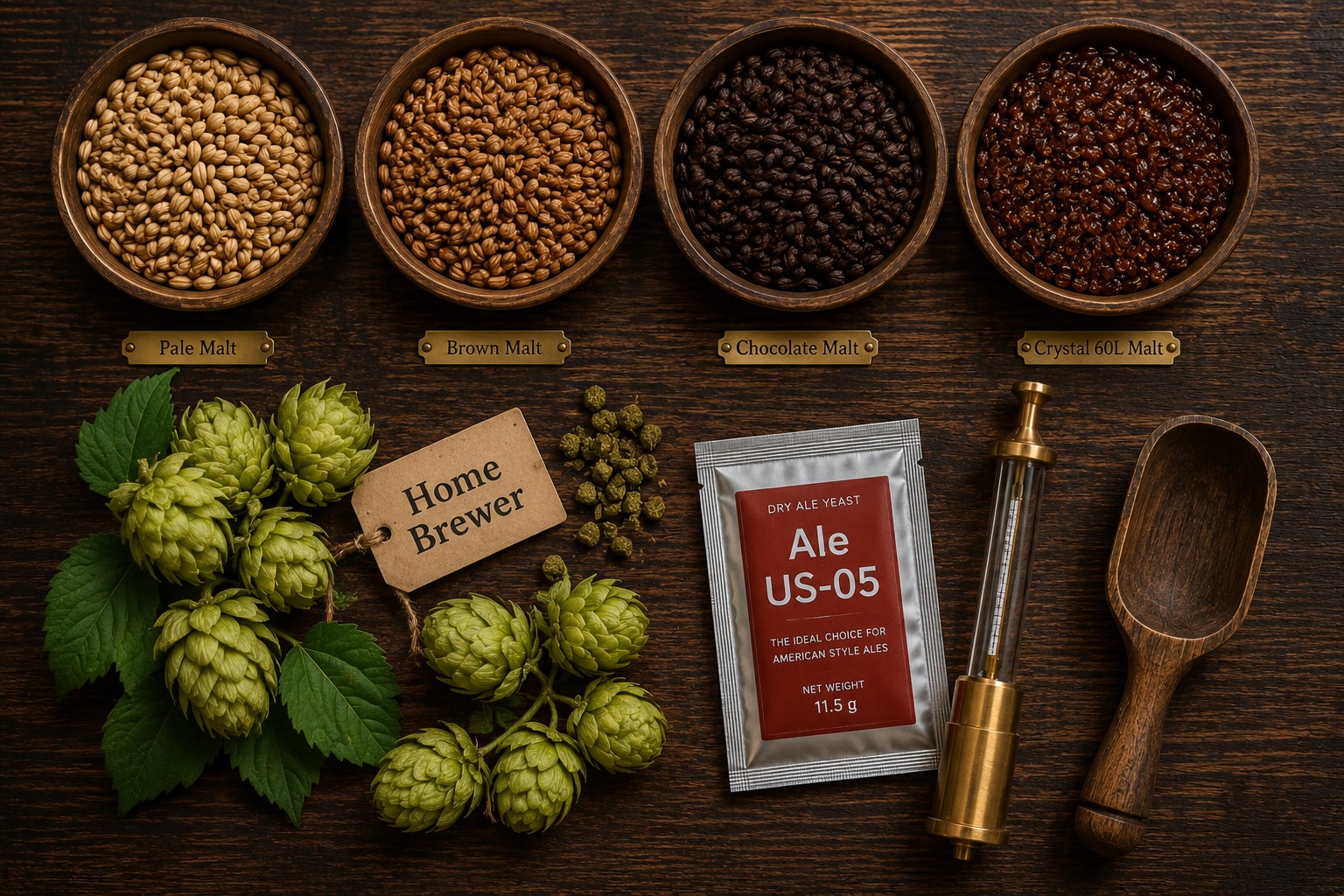
This recipe targets a 5 gal / 19 L batch of American Porter at approximately OG 1.054 / FG 1.014 / 5.3% ABV / 35 IBU / 30 SRM. Adapt to other sub-styles using the grain and yeast substitutions in Section 9.
Primary ingredients
| Ingredient | Quantity (19 L batch) | Role |
|---|---|---|
| Pale 2-row malt (UK Maris Otter or US 2-row) | 4.0 kg | The base — 88% of the grain bill, provides fermentable sugar and clean malt backbone |
| Brown malt | 250 g | The historical Porter character — bread crust, light toast, biscuit |
| Chocolate malt | 250 g | Color and chocolate aroma; the workhorse dark malt |
| Crystal/Caramel malt 60L | 250 g | Caramel sweetness and amber-ruby color; balances the dark roast |
| Northern Brewer hops (8% AA) | 30 g @ 60 min | Bittering — clean, slightly woody, traditional |
| Willamette hops (5% AA) | 15 g @ 15 min | Flavor — gentle floral-herbal |
| Willamette hops (5% AA) | 15 g @ 5 min | Aroma — soft, restrained |
| Yeast: SafAle US-05 or Wyeast 1056 American Ale | 1 sachet (11 g) or 1 pack | Clean American ale fermentation; lets malt express |
| Brewing water | 23 L pre-boil | Moderately mineral; see water profile below |
Grain bill: choose your character
The grain bill is where Porter sub-styles diverge. Adjust within these ranges to push the flavor:
| Adjustment | What it does | Trade-off |
|---|---|---|
| ↑ Brown malt (to 400 g) | More toast, more "bread crust" — closer to English Porter | Slightly drier finish, less chocolate |
| ↑ Chocolate malt (to 400 g) | More chocolate aroma, deeper color | Risk of acrid burn if over-pushed |
| ↓ Crystal 60L (to 100 g) | Drier, more bitter finish | Less caramel roundness |
| Swap 50 g Chocolate → 50 g Roasted Barley | Pushes toward Stout — sharper coffee bite | No longer strictly Porter |
| Add 100 g Black Patent Malt | Deeper color, more intense roast | Easy to overdo — start small |
Hop selection
| Hop | Origin | Flavor signature | Best for |
|---|---|---|---|
| Northern Brewer | UK/Germany | Clean bittering, light woody-mint | Bittering for any Porter |
| Willamette | USA | Soft floral, gentle hint of blackberry | American Porter aroma |
| Fuggle | UK | Earthy, herbal, classic English | English Porter |
| East Kent Goldings (EKG) | UK | Floral, marmalade, refined | English Porter |
| Cascade | USA | Grapefruit, pine — assertive | Hop-forward American Porter |
| Centennial | USA | Citrus, sharp pine | Modern "West Coast Porter" |
Yeast selection
| Yeast | Type | Character | Best for |
|---|---|---|---|
| SafAle US-05 / Wyeast 1056 | Clean American ale | Neutral, lets malt speak | American Porter |
| Wyeast 1968 London ESB / SafAle S-04 | English ale | Esters: stone fruit, light caramel | English Porter |
| Wyeast 2206 Bavarian Lager / SafLager W-34/70 | Lager | Cold ferment, clean, smooth | Baltic Porter |
| Wyeast 1728 Scottish Ale | Scottish ale | Soft, rounded, slightly sweet | Robust/Smoked Porter |
Water profile
Porter benefits from moderately mineral water with elevated bicarbonate — it counteracts the acidity of dark malts and produces a smoother mouthfeel.
| Ion | Target (ppm) | Notes |
|---|---|---|
| Calcium | 80–120 | Yeast health, mash pH |
| Sulfate | 50–80 | Modest — too high accentuates bitterness |
| Chloride | 80–120 | Higher than sulfate — pushes the malt-forward profile |
| Bicarbonate | 150–200 | Buffer the dark malt acidity; allows full chocolate expression |
For most home brewers, filtered tap water with 1 teaspoon (5 g) calcium chloride and 1 teaspoon (3 g) baking soda added to the mash hits the right ballpark.
Optional adjuncts (secondary flavor)
| Adjunct | Quantity (19 L batch) | When to add | Effect |
|---|---|---|---|
| Cold-brew coffee concentrate | 200–400 ml | At kegging | Coffee Porter — clean coffee top note |
| Vanilla beans (split) | 2 pods | Secondary, 7 days | Vanilla Porter — soft sweetness, rounded body |
| Cacao nibs | 100–200 g | Secondary, 7 days | Chocolate Porter — deepens cocoa aroma |
| Cinnamon stick | 1 stick | Last 5 min of boil | Spiced Porter — autumn warmth |
| Lactose | 250 g | Last 10 min of boil | Sweet/Pastry Porter — residual sweetness, fuller body |
6. Process
Equipment
| Item | Notes | Necessity |
|---|---|---|
| iGulu device (F1 or M-series) | Temperature-controlled fermentation + carbonation | ✅ Required |
| Mash tun (cooler or insulated kettle) | 25 L capacity for 5 gal batch | ✅ Required |
| Boil kettle | 30 L; allow headspace for hot break | ✅ Required |
| Wort chiller (immersion or counterflow) | Cool 25 L from 100°C → 18°C in <30 min | ✅ Required |
| Hydrometer or refractometer | Measure OG and FG | ✅ Required |
| Sanitizer (Star-San or equivalent) | Yeast-stage sanitation is non-negotiable | ✅ Required |
| Bottles or keg | 5 gal keg or ~50 × 330 ml bottles | ✅ Required |
| pH meter | Mash pH control | ⭐ Strongly recommended |
| Grain mill | Crush at the brewday for max freshness | ⭐ Strongly recommended |
Cleaning and sanitation notes
- Anything that touches cooled wort must be sanitized — not just clean
- Star-San at 1.6 ml/L, contact time 30 seconds, no rinse
- Iodophor is an acceptable substitute; chlorine bleach is not for plastic fermenters
Step 1: Mill and mash
Mill all four malts together — pale, brown, chocolate, crystal. The crush should be a clean break of the husk with a visibly cracked endosperm, not flour.
Heat 18 L of brewing water to 72°C / 162°F. Add the milled grain slowly while stirring to avoid clumps (dough balls). The combined temperature should land at 67°C / 152°F — the single-step infusion mash that produces a balanced Porter.
Hold at 67°C for 60 minutes. Check mash pH around 15 minutes in — target 5.2–5.4. If high, add a pinch of phosphoric acid or a small addition of acid malt; if low, add a pinch of baking soda.
Step 2: Sparge
After 60 minutes, mash out by raising to 76°C / 168°F for 10 minutes (locks the enzyme activity, thins the mash for runoff). Sparge with 76°C water until you collect 25 L of pre-boil wort at approximately 1.045 gravity. Sparge gently — vigorous sparging extracts harsh tannins from dark husks.
Step 3: Boil
Bring the 25 L to a rolling boil. Boil for 60 minutes with hop additions on this schedule:
| Time remaining | Addition | Quantity | Purpose |
|---|---|---|---|
| 60 min | Northern Brewer | 30 g | Bittering |
| 15 min | Willamette | 15 g | Flavor |
| 15 min | Yeast nutrient (if used) | 1 tsp | Yeast health |
| 5 min | Willamette | 15 g | Aroma |
| 5 min | Irish moss / Whirlfloc tablet | ½ tablet | Clarity |
| 0 min | Flameout | — | End of boil |
Step 4: Whirlpool and chill
At flameout, stir the wort to create a gentle whirlpool — pulls hop matter and trub to the center cone. Rest 15 minutes while you prepare the chiller.
Chill the wort to 18°C / 64°F within 30 minutes. Rapid chilling drops cold break proteins and dramatically lowers infection risk.
Step 5: Transfer and pitch yeast
Transfer the chilled wort to your sanitized fermenter (iGulu fermentation vessel or carboy), leaving as much trub behind as is practical. Aerate the wort vigorously — pour it back and forth between sanitized vessels, or use an oxygenation stone — yeast needs oxygen at pitch time.
Measure original gravity (OG) — target 1.054. Pitch the yeast.
Step 6: Primary fermentation
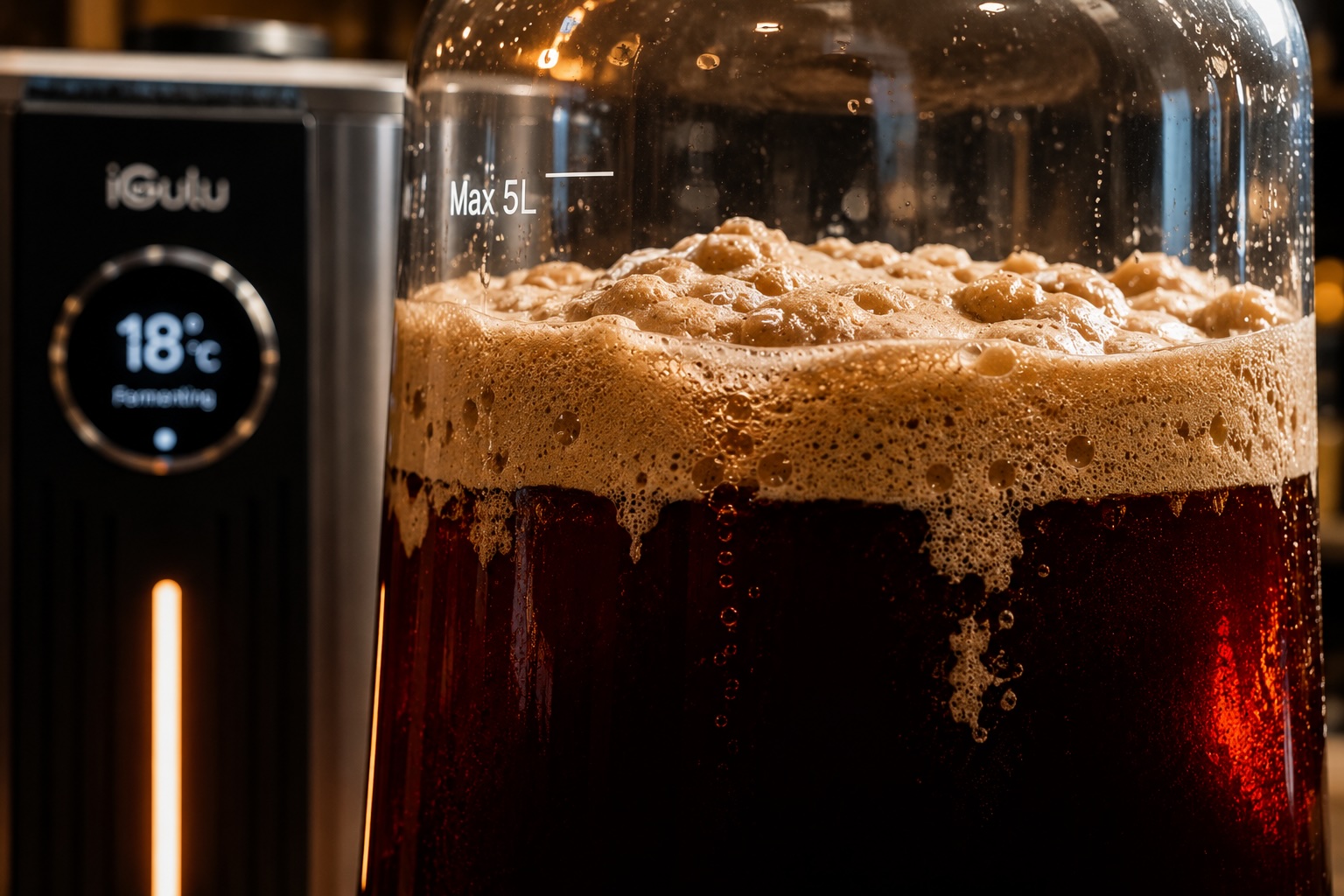
Place into the iGulu base, select [Ale] mode, set fermentation temperature to 18°C / 64°F. Press start.
Active fermentation kicks off in 12–24 hours and lasts 5–7 days. You'll see a tan krausen develop, peak, and fall. The iGulu's sealed chamber holds temperature stable through the exotherm — the most common amateur mistake is letting an ale ferment too warm (above 22°C), which produces solvent and harsh fusel notes.
Step 7: Diacetyl rest
On day 7, raise temperature to 20°C / 68°F for 48 hours. This "diacetyl rest" lets the yeast clean up the butterscotch-like diacetyl produced during fermentation. Skipping this step is the single most common cause of a Porter that tastes slightly soapy or oily.
Step 8: Cold crash and condition
Drop temperature to 2°C / 36°F for 48 hours minimum, 5 days preferred. Yeast and proteins drop out; the beer clarifies dramatically.
Measure final gravity (FG) — target 1.014. Calculate ABV: (OG - FG) × 131.25 = (1.054 - 1.014) × 131.25 = 5.25% ABV.
Step 9: Carbonate and package
Transfer to bottles or keg. For bottles: prime with 5 g priming sugar per liter for ~2.2 volumes CO₂; condition at 20°C for 10–14 days, then refrigerate.
For keg/iGulu Sparkling Mode: force-carbonate at 12 psi at 2°C for 48 hours, or use the iGulu carbonation profile [Porter: 2.2 vol].
Step 10: Mature and serve
Porter benefits from 2 weeks of cold conditioning after carbonation — the chocolate notes integrate and the hop bitterness softens into the malt. Don't drink it the day it's ready; let it become itself.
Serve at 8–12°C in a pint glass, tulip, or stemmed nonic. Hold the glass at 45°, pour smoothly down the side, then straighten and pour into the center to build the tan head.
7. iGulu Settings
How Porter works on iGulu
Porter is a forgiving ale, but it has two failure modes that the iGulu's sealed temperature control specifically eliminates: fermentation overheating (produces fusel alcohols and harsh hot-burn finish) and uneven cold conditioning (leaves haze and rough mouthfeel). The iGulu F1 holds the ferment within ±0.5°C across the full cycle, which is the single largest jump in quality you can give a home Porter.
✅ Important: iGulu's recommended fermentation settings have been validated by the product team and apply to users in every region. The device handles environmental differences automatically — no regional adjustments needed.
Recommended parameters — Standard American Porter
| Parameter | Standard value | Notes |
|---|---|---|
| Mode | [Ale] or [Porter] preset | Standard ale fermentation profile |
| Pitch temperature | 18°C / 64°F | Cooler pitch = cleaner ester profile |
| Primary fermentation temperature | 18°C / 64°F | The iGulu sweet spot for clean American ale character |
| Primary fermentation time | 7 days | Until gravity is stable for 48 hours |
| Diacetyl rest temperature | 20°C / 68°F | Critical — do not skip |
| Diacetyl rest time | 2 days | Cleans up butterscotch notes |
| Cold crash temperature | 2°C / 36°F | Drops yeast and proteins out |
| Cold crash time | 2–5 days | Longer = clearer beer |
| Carbonation target | 2.2 volumes CO₂ | Lower than lager; lets malt express |
| Sparkling Mode pressure | 12 psi @ 2°C | Achieves 2.2 vol in 48 hours |
Flavor fine-tuning
| Flavor target | Mash temp | Ferm temp | Hop additions | Result |
|---|---|---|---|---|
| Standard balanced (default) | 67°C / 152°F | 18°C / 64°F | As listed | Smooth, chocolate-forward, dry finish |
| Drier, more bitter | 65°C / 149°F | 18°C / 64°F | +10 g Northern Brewer @ 60 min | Crisper finish, more hop assertion |
| Sweeter, rounder | 69°C / 156°F | 18°C / 64°F | Reduce 15-min hop by 5 g | Fuller body, more residual maltose |
| More roasted | 67°C / 152°F | 18°C / 64°F | Add 100 g Black Patent malt | Deeper roast, near-Stout territory |
| English-style esters | 67°C / 152°F | 20°C / 68°F | Use S-04, swap to EKG hops | Stone fruit, marmalade, traditional London character |
| Baltic-style (advanced) | 67°C / 152°F | 10°C / 50°F lager yeast | Same hop schedule, longer ferment | See Variations |
iGulu sub-style presets
| Sub-style | Mode | Primary temp | Primary time | Carbonation |
|---|---|---|---|---|
| English Porter | [Ale] | 20°C / 68°F | 7 days | 2.0 vol |
| American Porter | [Ale] | 18°C / 64°F | 7 days | 2.2 vol |
| Baltic Porter | [Lager] | 10°C / 50°F | 14 days + 30 days lagering | 2.4 vol |
| Imperial Porter | [Ale] | 20°C / 68°F | 14 days | 2.0 vol |
Drinking your iGulu Porter
Serve cold but not ice-cold. Aim for 10°C / 50°F for an American Porter — cold enough to refresh, warm enough that the chocolate and coffee aromatics can volatilize. Pour into a pint glass with a deliberate head. The first sniff should be coffee and chocolate, not alcohol; the first sip should be smooth, dry, and finish clean.
8. FAQ
Q: My Porter tastes burnt or ashy — what went wrong?
A: Almost always one of three causes: (1) over-roasted dark malts — switch to a fresher batch and reduce the chocolate/black malt fraction; (2) sparge water too hot (>80°C) extracting husk tannins — sparge at 76°C; (3) excessively long boil with dark malts in. Porter recipes that add dark malts only in the last 10 minutes of mash ("cold steeping") avoid this entirely — try it next batch.
Q: What's the actual difference between a Porter and a Stout?
A: Historically there is none — Stout was originally "Stout Porter," the stronger version. The modern working distinction: Porter relies on brown and chocolate malts for color, producing chocolate and toast notes; Stout typically adds roasted unmalted barley, producing sharper coffee and a more acrid roast. Stouts are also generally fuller-bodied. The category boundary is blurry — many modern beers could be called either.
Q: Can I age a Porter? For how long?
A: Standard American/English Porter (5–6% ABV) is at its best 2–8 weeks after carbonation and declines after 4 months. Baltic Porters at 8%+ ABV improve for 6–18 months in cold storage — they're built for aging, develop dark fruit, leather, and tobacco notes. Imperial Porters at 9%+ can age 2+ years like wine.
Q: Do I really need brown malt? It's hard to find locally.
A: Brown malt is the historical defining character of English Porter, but it is not essential for American Porter. Substitutes: increase chocolate malt by 100 g and add 100 g Victory malt or Biscuit malt — you'll get the toast/bread character without true brown malt. American Porter recipes routinely omit brown malt entirely.
Q: My Porter is hazy after a month. Is that bad?
A: For drinkability, no — chill haze is purely visual and doesn't affect flavor. For style, slight haze is acceptable in Porter (unlike a Pilsner). If you want clarity: extend the cold crash to 7 days, use Irish moss in the boil, and consider gelatin fining in the secondary. Time alone fixes most haze.
Q: Can I add coffee or vanilla? When?
A: Yes — Porter takes adjuncts beautifully. Add cold-brew coffee concentrate (200–400 ml) at kegging or bottling, not during fermentation (the heat drives off aroma). For vanilla, add 2 split pods to the fermenter for the last 7 days, then remove. Cacao nibs (100–200 g) for the last 7–14 days in secondary.
Q: My OG was 1.048 instead of 1.054 — should I worry?
A: No. You'll land at a slightly lower-alcohol Porter (~4.6% ABV) — still in style, still delicious. Mash efficiency drift of 5–10% is normal between systems and even between batches on the same system. For next batch: mill the grain a touch finer or extend the mash to 75 minutes.
Q: What glassware should I use?
A: A British nonic pint (568 ml, the dimpled glass with a bulge near the rim) is the historical Porter glass. Tulip-shaped glasses concentrate aroma — best for Baltic and Imperial Porters. Avoid mugs and tall pilsner glasses — both flatten the experience.
9. Variations and DIY
The Porter family tree
Porter is the trunk; the variations below are the branches the style has grown over three centuries. The base recipe above is the American Porter — adapt with these substitutions.
English Porter (BJCP 13C)
The historically faithful version, what a Londoner of 1850 would have drunk.
| Change from base recipe | Specifics |
|---|---|
| Base malt | Switch to UK Maris Otter (already a great choice) |
| Grain bill | Increase brown malt to 400 g; reduce chocolate to 150 g |
| Hops | Replace Northern Brewer with East Kent Goldings 30 g @ 60 min; replace Willamette with Fuggle 15 g @ 15 min and 15 g @ 5 min |
| Yeast | Wyeast 1968 London ESB or SafAle S-04 |
| Fermentation temp | 20°C / 68°F — slightly warmer for English ester development |
| OG / FG / ABV | 1.045 / 1.012 / 4.3% |
| Character | Biscuit and toast forward, soft caramel, restrained roast, stone-fruit ale yeast esters |
Baltic Porter (BJCP 9C)
The lager-fermented Northern European derivative. The trickiest sub-style — requires a lager fermentation profile and patience.
| Change from base recipe | Specifics |
|---|---|
| Grain bill | Pale 2-row 5.5 kg, Munich malt 500 g, Chocolate malt 300 g, Brown malt 200 g, Crystal 80L 200 g |
| Hops | Saaz 30 g @ 60 min + Saaz 15 g @ 15 min — noble hops, low IBU |
| Yeast | SafLager W-34/70 or Wyeast 2206 Bavarian Lager — pitch a large active starter |
| Fermentation temp | 10°C / 50°F — true cold lager fermentation |
| Primary time | 14 days primary + 30+ days lagering at 2°C |
| OG / FG / ABV | 1.080 / 1.020 / 7.8% |
| Character | Silky, dense, stone-fruit (plum, raisin, dark cherry), low bitterness, clean lager finish |
| iGulu mode | [Lager] |
Robust Porter
A transitional craft category — between American Porter and American Stout. The "modern" big American Porter.
| Change from base recipe | Specifics |
|---|---|
| Grain bill | Add 100 g Black Patent malt + 150 g Roasted Barley to base |
| Hops | Increase Northern Brewer to 40 g @ 60 min; add 20 g Cascade @ 10 min for citrus lift |
| ABV target | 5.5–6.5% |
| Character | Sharper roast, more hop assertion, leans toward American Stout territory |
Smoked Porter
Inspired by Alaskan Smoked Porter (one of the most decorated American beers in history).
| Change from base recipe | Specifics |
|---|---|
| Grain bill | Replace 800 g of pale malt with 800 g rauchmalz (beechwood-smoked malt) — 20% of base |
| Other | Keep all other ingredients identical |
| Character | Campfire smoke woven through chocolate and coffee; gets darker and rounder with age |
| Caution | A 20% smoked malt addition reads as moderate; 30%+ is intense and divisive — start at 15–20% |
Imperial Porter
The American craft maximalist version — built to age, share, sip slowly.
| Change from base recipe | Specifics |
|---|---|
| Grain bill | Scale base recipe up 1.6×; add 500 g flaked oats for body |
| Hops | Scale to 45 g Northern Brewer @ 60 min + 30 g Willamette late |
| Yeast | Use Wyeast 1056 or a high-attenuation English ale yeast; consider a large starter |
| Fermentation temp | 20°C / 68°F — warmer to drive complete attenuation |
| OG / FG / ABV | 1.090 / 1.020 / 9.2% |
| Character | Dense, warming, dark chocolate, coffee, dried fruit; benefits from 3–6 months cold aging |
Pastry / Adjunct Porter (modern craft)
The dessert-leaning modern variant. Polarizing — but a fun batch to brew once.
| Change from base recipe | Specifics |
|---|---|
| Adjuncts | Add 250 g lactose at last 10 min of boil; add 2 split vanilla beans + 200 g cacao nibs to secondary for 10 days |
| Optional | 150 g toasted coconut, 2 cinnamon sticks, or 300 g brown sugar for variant pastry profiles |
| FG | Higher residual sweetness (~1.020) due to unfermentable lactose |
| Character | Dessert in a glass — vanilla, chocolate, coconut, full body, lower roast |
Beyond the glass: Porter as ingredient
- Beer-braised short ribs: Porter's roast and dark malt complement long braises — use 500 ml in place of stock
- Chocolate Porter cake: Replace half the buttermilk in a devil's food cake with Porter — intensifies chocolate, adds malt complexity
- Oyster sauce variant: Reduce 1 cup of Porter with soy sauce and brown sugar for a porter-glaze on grilled meats
- Vinegar mother substrate: A flat aged Porter is an excellent starting wort for malt vinegar (covered in Vol. VI · Fermentation Lab)
- Ice cream base: Reduce 500 ml Porter to 150 ml syrup; fold into vanilla ice cream base for a Porter float in solid form
Zero-Proof Porter (iGulu Sparkling Mode adaptation)
For drivers, pregnant brewers, or anyone wanting the flavor without the alcohol:
| Step | Adjustment |
|---|---|
| Mash | Standard, full grain bill |
| Boil | Standard, full hop schedule |
| Ferment | Skip — do not pitch yeast |
| iGulu setting | Cool wort to 4°C, transfer to Sparkling Mode at 15 psi |
| Result | Carbonated malt drink with full Porter flavor and 0% ABV |
| Notes | Sweeter than standard Porter (no fermentation drying); store cold; drink within 5 days |
10. Food Pairings
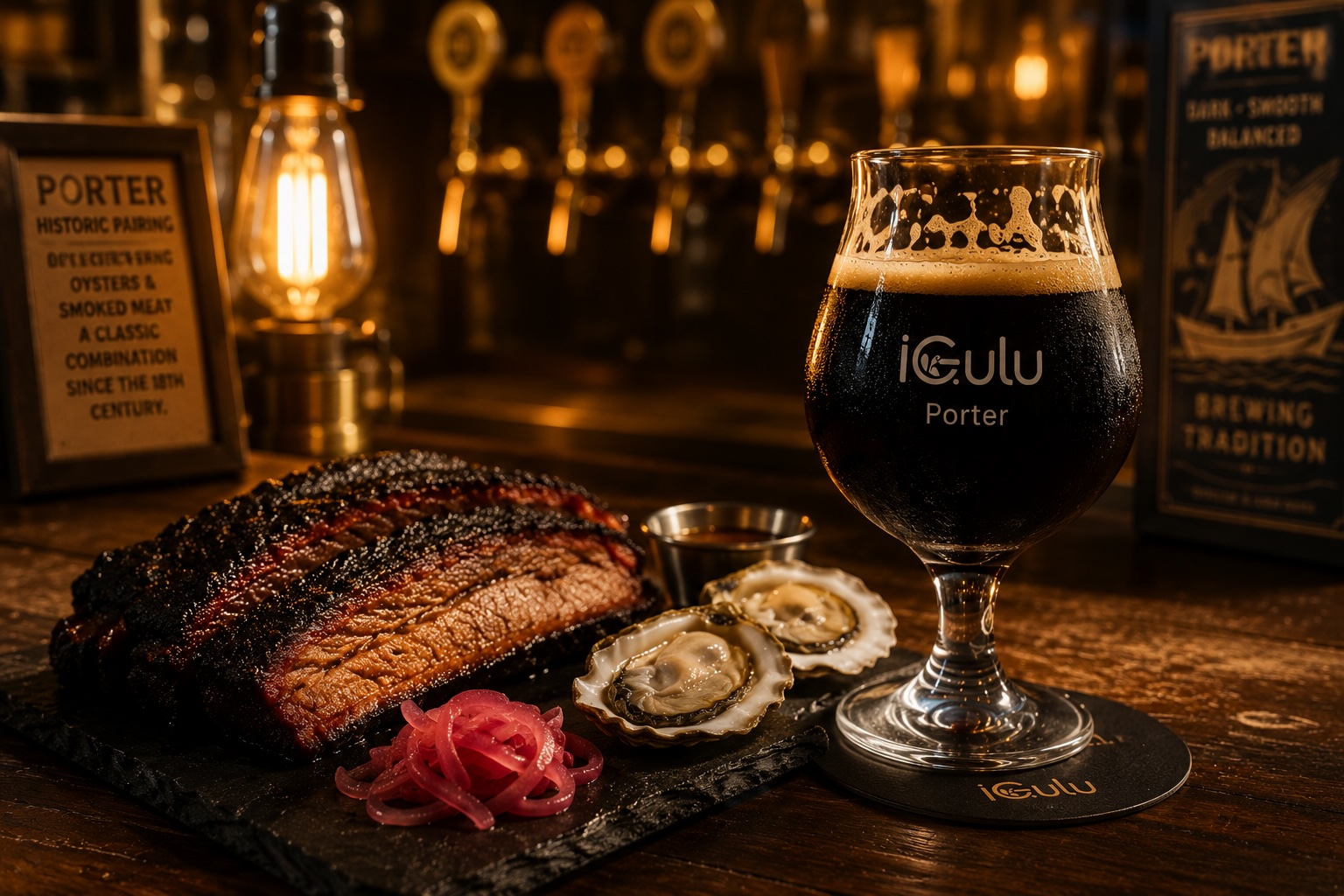
Porter is one of the most food-friendly beers ever brewed — the dry finish and chocolate-coffee aromatics bridge sweet and savory better than almost any other style.
- Grilled and smoked meats: Porter's roast echoes the Maillard reaction on a steak crust or a brisket bark. Pair an American Porter with a smoked brisket sandwich; the bitterness cuts the fat, the chocolate notes harmonize with the smoke.
- Oysters and shellfish: The historical London pairing — Porter and oysters are a documented 18th-century meal. The mineral salinity of fresh oysters cleans the palate between sips; the Porter's dry finish refreshes between bites.
- Aged cheddar and blue cheese: Sharp aged cheddar (12+ months) and a strong blue (Stilton, Roquefort) both stand up to Porter's roast. The beer's sweetness counterbalances the cheese's salt and funk.
- Chocolate desserts: Echo-pair — flourless chocolate cake, dark chocolate truffles, brownies with sea salt. Imperial Porter especially shines here.
- Barbecue: American BBQ with sweet-smoky sauces (Kansas City, Memphis) calls for an American Porter. Hops cut the sugar; malt matches the smoke.
- Coffee desserts (tiramisu, espresso panna cotta): Baltic Porter's stone-fruit and the coffee notes in tiramisu compound into something larger than either alone.
- Roasted root vegetables and mushroom dishes: A vegetarian pairing — roasted beets, smoked mushroom ragout, charred carrots — the earthy sweetness pairs with Porter's malt depth.
This chapter is part of the iGulu Home Brewing Bible · Craft Beer series. If you brew your own variant, please contribute it back via GitHub — together we keep this brewing guide alive.
© 2026 CytoEvo Inc. · iGulu Home Brewing Bible · English Draft